
50 years since the death of CS Lewis, we take a look back at early Guardian reviews of his Narnia stories, and the fierce debate over his legacy
CS Lewis, one of the most popular children's authors of the 20th century, died at the age of 64 on 22 November 1963 (the same day that JFK was shot and fellow author Aldous Huxley died).
Early reviews for the Narnia series for which he is best known were small and sparse. Each new installment would earn a small square of text in the Manchester Guardian's weekly review of children's books, written either by Mary Crozier or Naomi Lewis. While these reviews were positive, they were by no means gushing.
This piece from 6 December 1951 praises Prince Caspian, the second Narnia book to be published, for creating a "lucid" and believable fantasy world. What is more notable however are the other books reviewed, gifted the same space as Lewis's work (and in some cases more enthusiastic praise); most of these have now faded into obscurity.
Luckily, readers were more enthusiastic than the critics, and the popularity of Narnia grew steadily. On 8 July 1955, after the publication of the sixth and penultimate book, The Magician's Nephew (chronologically the first in the series), Mary Crozier went as far as to suggest that the series may become a "minor children's classic."
Yet his journey to borderline national treasure, via countless stage and screen adaptations of his life and work, has not been without its opponents.
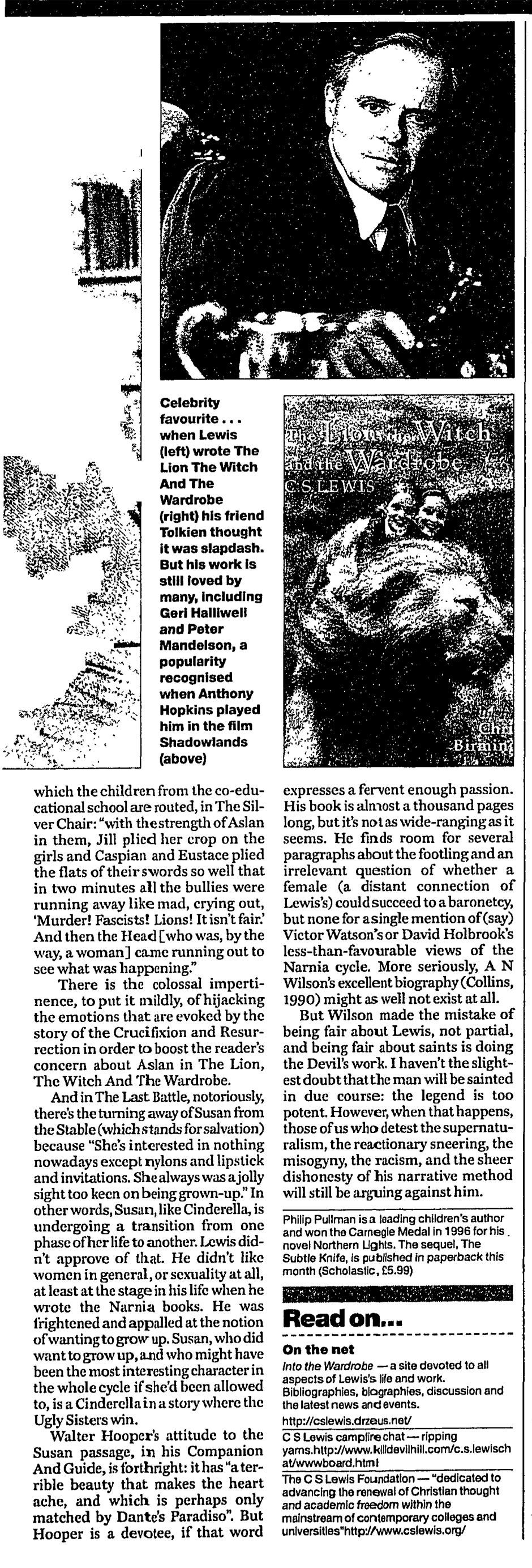
On 1 October 1998 the Guardian featured this harsh critique from Philip Pullman, the children's author of the distinctly anti-monotheistic His Dark Materials trilogy. Pullman described the Narnia series, and in particular its Christian allegories, as "nauseating drivel" and made his disdain for "the racism and sheer dishonesty of the narrative method" painfully clear (click here for part two).
This criticism was echoed by the late Christopher Hitchens, who, in his bestselling tirade God Is Not Great, called Lewis's particular brand of religious fervour "dreary and absurd."
Lewis was by no means lacking defenders. The letters page from 6 October 1998 shows the ire that Pullman provoked, with one letter decrying his piece as "mean-spirited and biased", another defiantly praising Narnia for its feminist qualities.
Pullman's critique also attracted the anger of Hitchens' more conservatively-minded brother, Peter, who described him in a Mail on Sunday column in January 2002 as "the anti-Lewis, the one the atheists would have been praying for, if atheists prayed." The headline proclaimed, "This is the most dangerous author in Britain."
Whichever side you come down on, the debate over his legacy and the enduring popularity of his work shows that CS Lewis is arguably just as relevant now as he was at his death 50 years ago.


0 comments:
Post a Comment