Pages
Thursday, October 31, 2013
Stanley Hotel Hosts Halloween Ball: Masquerade From Stephen King's 'The Shining' Comes To Life
If you were to ask author Stephen King, he might say that masquerade balls are best when they're secluded in the dark shadows of the Colorado mountains at The Stanley Hotel, where his "Shining" character Jack Torrance went mad.
It's rumored to be haunted, it is the setting of one of the creepiest books of all time and it hosts a Halloween ball that recreates one of the most haunting moments from the story -- The Stanley Hotel could be the spookiest place to be on Halloween.
"In King's classic novel, a masquerade ball full of 'past guests' takes place in the ballroom and we thought this was the perfect way to offer a unique guest experience to our current visitors," Rick Benton, General Manager of The Stanley Hotel, said in a press release. "We've hosted this event for more than 15 years and it's always a huge draw -- people come from all over the world to celebrate Halloween at The Stanley."
Take a look inside past masquerade balls at The Stanley:
Harry Reid's Source On Mitt Romney's Taxes Was Jon Huntsman Sr., Book Claims
The New York Times on Thursday offered details from "Double Down: Game Change 2012," a behind-the-scenes account of the election by political reporters Mark Halperin and John Heilemann. Among the nuggets in the book is the reveal that Reid's source was Huntsman, a longtime backer of Romney.
In a July 2012 interview with The Huffington Post, Reid said a Bain Capital investor had told him that the former Massachusetts governor "didn't pay any taxes for 10 years."
"He didn't pay taxes for 10 years! Now, do I know that that's true? Well, I'm not certain," Reid said. "But obviously he can't release those tax returns. How would it look?"
Reid stood by the claim throughout the campaign.
Huntsman Sr., the father of one of Romney's primary rivals, former Utah governor Jon Huntsman Jr., was suspected by some to be Reid's source. While Huntsman Sr. denied to the Washington Post's Greg Sargent that he was behind the tax delinquency rumors, he pressed Romney to release his returns to clear the air.
“I feel very badly that Mitt won’t release his taxes and won’t be fair with the American people,” he said.
The upcoming book also offers unflattering details on Huntsman Jr.'s presidential bid. The Times' Jonathan Martin reports:
As Mr. Obama’s ambassador to China, he repeatedly assured top White House officials that he was not considering a Republican presidential bid, even as he was meeting with potential campaign strategists during a trip to his Washington home around Christmas 2011. And while Mr. Huntsman was in Beijing, his wife was exchanging emails with his eventual consultant, trying to be discreet about their political plans by referring to her husband only with the code word “HE.”
Thor: The Dark World – Review
With Tom Hiddleston overshadowed by an apocalyptically dull new villain, Thor's return is punctuated by thunderous boredom
This new Thor film delivers a hammer-blow of boredom to the back of the head. It is another franchise product from the Marvel pipeline, conceived without much inspiration in a CGI-green screen world, and without the sprightliness and novelty of the previous Thor outing, directed by Kenneth Branagh. Chris Hemsworth returns as the great god, still carrying a torch, as well as that hammer, for his Earthling love: astrophysicist hottie Jane Foster, gamely played by Natalie Portman. But now he faces a new enemy, the apocalyptically boring Malekith, leader of the Dark Elves, played by Christopher Eccleston and hell-bent on unleashing a fog of dullness on the universe. Malekith stands around glowering with pale-faced, pointy-eared resentment, like a mature student who has been thrown out of a Goth pub for smoking.
Catastrophically, this development downgrades the status of this franchise's star performer: Thor's wicked brother Loki, played by Tom Hiddleston. Loki is (once again) languishing in Lecteresque imprisonment and Hiddleston brings to it all the usual silky-voiced malice, wit and fun, like James Mason's wicked great-nephew. He's given a bit to do when Thor realises he must make common cause with this duplicitous sibling to defeat Malekith. But his sidelining is a big disappointment. Even Hiddleston can't rescue this Norse epic of tedium.
- Superhero movies
- Science fiction and fantasy
- Tom Hiddleston
- Natalie Portman
- Marvel
- Walt Disney Company
- Comics and graphic novels
13 Facts You Didn't Know About 'Beetlejuice'

The classic film directed by Tim Burton came out 25 years ago, and tells the story of the recently departed who have become ghosts, and their journey through the Netherworld and our world. As such, what better time than Halloween to educate fans on little known facts and trivia about everyone's favorite "Ghost With the Most"?
1. The original tone was much darker:

While "Beetlejuice" deals with death and ghosts, is still often described as a comedy. That wouldn't have been the case if producers had stuck to the original screenplay. As The Playlist noted earlier this year, the original script included more gruesome violence and presented Michael Keaton's title character in this way: "He was envisioned as leather-winged demon whose humanoid form is that of a squat Middle Eastern man (subsequent drafts had him talking in a kind of African American pidgin dialect)."
Also, instead of the climatic scene where Beetlejuce tries to marry Lydia (Winona Ryder), in the original script he tries to rape her.
2. Beetlejuice as played by ... Sammy Davis Jr.?
Beetlejuice was originally a more laid back, lounge singer-type character, so a former Rat Packer would've made sense. Luckily, David Geffen, who was overseeing the development of the film at Warner Bros, suggested Keaton, who eventually won the role.

3. You know who else was almost cast in the film's iconic roles?
Juliette Lewis was almost Lydia instead of Winona Ryder!

Delia Deetz (Catherine O'Hara) was almost played by Anjelica Huston!

4. Beetlejuice's Screen Time
Even though the movie is called "Beetlejuice," the character only has 17 minutes of screen time out of a 92-minute running time. Keaton spent two weeks filming his part.

5. The name.
Beetlejuice is kind of a strange name when you think about it. Where does it come from? It's based on the Betelgeuse star which is housed in the Orion constellation and is the ninth brightest star in the night sky. Maybe the name just had a nice ring to it?

6. Deleted Scenes
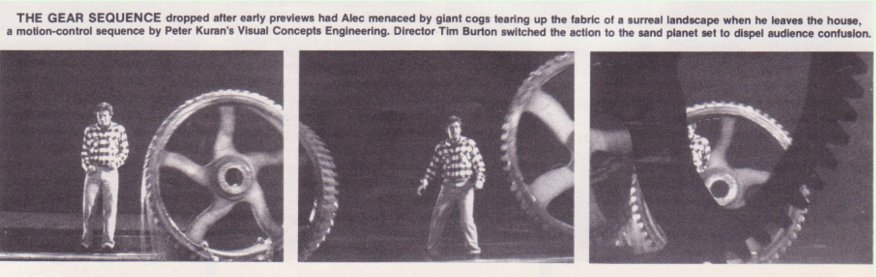
There were several scenes written that never made it into the final film, including one that showed the world of limbo between the living and the dead as giant gears (and hands of clocks) cut through actual fabrics that represented time:

Here's the scene from one of the original scripts:
FOREGROUND - ENORMOUS GEARED WHEEL
-- The size of a man -- rolls by, tearing up the unseamed
ground. Something pours up out of the tear -- ooze or
stuffing.
Adam runs forward and stares after the wheel, which is
now out of sight.
TWO SMALLER GEARS
looking very much like components of a giant watch --
spin along behind him. One of them veers suddenly
toward him, and though Adam jumps out of the way, the
gear snags his trouser leg and shreds it. LOUD TICKING.
A perfectly enormous gear comes barreling toward him.
Adam leaps out of its way. The gear turns, fish-tailing,
kicking up ooze and stuffing.
Adam flings himself suddenly to the right, but trips into
the path of the gear. As he's about to be crushed, he's
suddenly jerked up to safety.
7. The Number 3
Everyone knows if you say Beetlejuice's name three times he appears, but the number three is used multiple times in the film. Aside from Beetlejuice's name the Maitlands also say the word "home" three times to escape Beetlejuice, and it's the number of times they knock on the door to get to the After Life.
8. "Day-O"
The song by Harry Belafonte used during the dinner party possession scene is one of the most memorable moments in the movie:
But viewers can also faintly hear film composer Danny Elfman singing "Day-O" in the opening credit sequence when the Geffen logo appears (Elfman's vocals were added during post-production):
Also, when Glenn Shadix who played Otho, passed away at the age of 58 in 2010, "Day-O" was the last song played at his memorial service.

9. The Animated Series
"Beetlejuice" was a hit during its original release which of course led to merchandise like toys, and a cartoon continuing the adventures of Beetlejuice and Lydia:
The animated series proved so successful that it aired on ABC Saturday mornings, while also airing on Fox weekday afternoons, for two seasons. Over 100 episodes were produced.
10. If You're Recently Departed ...
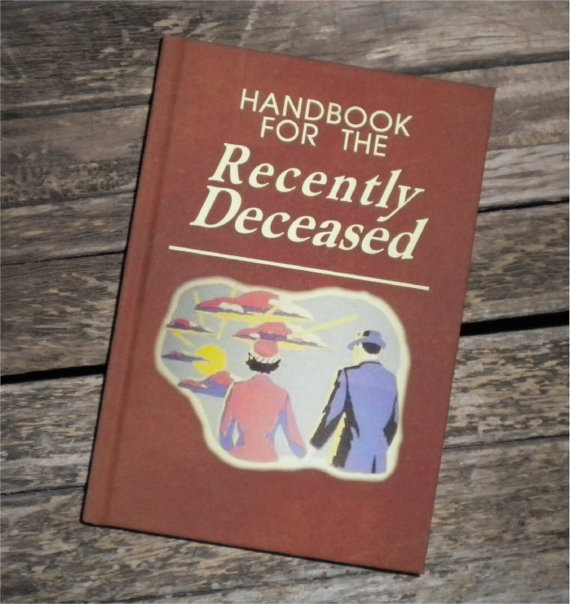
Speaking of merchandise, if you want your own "Handbook For the Recently Deceased" look no further than Etsy!

11. Rock And Roll Graveyard Revue
If you want to see Beetlejuice in the flesh, book a flight to Universal Studios, where Beetlejuice's Rock And Roll Graveyard Revue has been playing since 1992. Beetlejuice is still rocking audiences today at the Universal Studios in Orlando and Japan, but was replaced by Spider-Man Rocks at the Universal Studios Hollywood location in 2002.
Check out the video below to see some of the graveyard rock n' roll action:
12. The Sequel
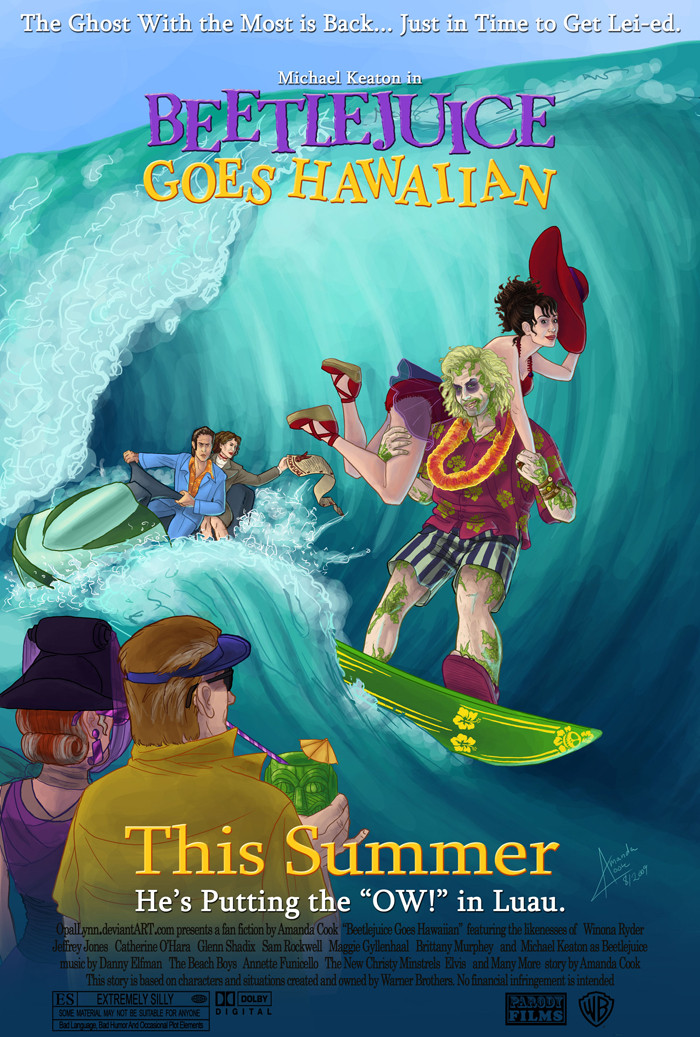
A sequel to "Beetlejuice" has been Hollywood lore for years. Ever since the original was released and proved successful, Warner Bros. wanted Tim Burton to make a sequel. The studio eventually brought on Jonathan Gems (who went on to write the "Mars Attacks!" movie for Burton) and traded the New England setting of the original for a tropical one, in what eventually became known as "Beetlejuice Goes Hawaiian."

A synopsis of the never-made film from Creature Features reads:
Meanwhile, the now college-aged Lydia is visiting a Hawaiian tropical island, Kanooka, where her eternally obnoxious parents are planning to open a fancy hotel, “The Deetz Paradise.” A group of local beatnicks are upset that the hotel will ruin the island’s environment but their complaints to Deetz fall on deaf ears. In addition to the beatnicks, a band of ancient Hawaiian ghosts are none to pleased about the hotel; they try to recruit Beetlejuice to frighten away Deetz and his developers, but he declines because his license to scare has been revoked.
The script ends with a climatic scene where Beetlejuice wreaks havoc on the island by turning into a creature named "Juicifer," and Lydia summoning a giant tidal wave that washes the island clean of all the demonic creatures conjured by Beetlejuice. The proposed sequel was bizarre to say the least, but screenwriter Gems defended Burton's idea: "Tim thought it would be funny to match the surfing backdrop of a beach movie with some sort of German Expressionism, because they're totally wrong together."
Now 25 years later, it is reported that a sequel is finally going forward with Burton in talks to direct and Keaton returning to star. Seth Grahame-Smith, who wrote "Abraham Lincoln: Vampire Hunter" and Burton's version of "Dark Shadows," is working on the script, so whether the Ghost With the Most goes tropical remains to be seen.
13. "Beetlejuice 2" Could Be "Prismatic"
And if a sequel goes through which pop star would love to be involved? Ms. "California Gurl" herself, Katy Perry, as she recently said in a Q&A before her Hollywood Bowl concert earlier this month.

So what are you waiting for? Say his name three times and spend the most ghoulish day of the year with your favorite ghost, Beetlejuice!
19 Tips to Keep Your Writing Career in High Gear
I've called on six writers of various kinds to share their experiences with eight writerly problems they've encountered. Although not a comprehensive list, we've all been through most of these issues -- if you're a writer, I'm betting you have too:
1 -- Writer's Block/Perfectionism
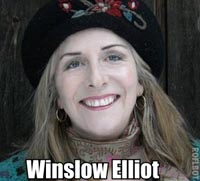
Winslow Eliot : My relationship with writing is more of a commitment than a mood swing. To only consider the moment your pen touches the sheet of paper and ink flows to be writing is nonsense. Like my marriage, there may be times when we're having issues; that doesn't negate the relationship -- that is the relationship.
Sheilaa Hite : Balance is the key. Knowing when and how to let my work 'fly from the nest' is as creative, challenging and satisfying as making it come to life. I use my senses and listen to my creation -- it knows when it's ready.
Bill Brenner : If I need to get something out there fast, it's going to be less polished than I'd like. If I'm writing about something I've written about a lot it, moves faster. If I'm opining about news events, it takes more time and word wrestling.
Cheryl Snapp Conner : Being increasingly regarded as an authority on subjects that matter -- then working to ensure I live up to that -- it's incredible. Humbling, too -- there are always detractors at the door ready to interpret what you do through some bizarre personal filter and knock you flat -- but that's life, and it's to be expected.
Elona Shelley : A perfect piece of writing? I'm constantly reminded that perfection is an illusion as I receive feedback. What's near perfect for one person, someone else finds it's not worth reading. Write what you feel to the best of your ability and let the chips fall.
Adrienne Monson : If you've revised it to the point of perfection, you've probably lost something in your narrative voice and in the characters. After I've revised a manuscript twice, I'll send it to BETA readers, revise it two more times, then won't look at it for a month. I'll read through and revise once more before sending to my editor.
2 -- Fear of Selling/Negotiating
Shelley: Being a first-timer, I didn't realize that I'd have to sell my own book; I thought once it was printed the distributor would take it from there. But I'm passionate about the message and that kept fear at bay.
Monson: It's hard to sell your book sometimes, because part of getting people to buy it is making them like you. It gets easier. Help other authors promote their books; they're usually more than happy to reciprocate.
3 -- Too Much Competition
Eliot: I have three rules to deal with this: 1. Write what you love to read. Don't try to write what will appeal to the masses. 2. Never compete, only excel. I look at my novels, readers and fans as individuals. 3. Write more than one book. My experience has been that one book sells the next.
4 -- Getting Clients/Work
Hite: Let them know you can provide an invaluable service to them. In any successful business promotion is the key. Advertising, networking, social media interactions and good old word of mouth testimonials keep the revenue and promotion stream flowing.
Lowery: Start a blog; the more you write, the better you'll get and the easier it is to pitch your work to better outlets. Write all kinds of articles. Read other similar articles for tone and style. If you can learn to write quickly and well, you can work your way up the writing ladder inside a year.
5 -- Expressing Your Thoughts
Hite: I love words. They're the building blocks of conscious expression and the connecting bridges between human beings. Language is very powerful and can be used to heal or destroy. Use words positively; they can be as comforting as a hug or as lethal as a sword.
Brenner: Don't worry about other people's opinions. Don't worry about being a perfect writer. Just get it out onto a page and go from there.
Conner: Communication is power, and writing is a way to make a difference -- maybe for a few or perhaps profoundly for many -- but it is a way to leave our legacy behind in the world. We're doing it in all that we do, so why not do it deliberately with forethought and power?
Monson: It's easy to get stuck in phrases or words and use them throughout your writing. In most cases, you won't realize you're doing. Try using a critique group -- I love it. Use the Word search feature to replace that redundant word/phrase with other things or delete it altogether.
6 -- Lack of Rest
Shelley: Find what works for you and stick to it. I like writing early in the morning, and when I get on a roll I usually wake up feeling energized by the ideas that are flowing. It's a delicate balance because I need to write when I have that energy, otherwise my writing loses its passion.
7 -- Lack of Productivity
Eliot: Commit a certain number of hours a day to writing. I sit and write at the same time, in the same place, every day, and nothing is allowed to interfere.
Brenner: I've found that if you lack passion for something, you're going to find ways not to do it. Just be yourself. If you have passion for a subject and want to write, just do it.
8 -- Lack of Ideas
Conner: I never suffer from this because there's so much going on in the world. The greatest thing about writing for me is that, in an increasingly unsettled world, I take comfort in knowing that we writers are taking visible steps to leave a mark; a legacy for our children and grandchildren. We've "walked the talk," willing to stand up publically for what we said we stood for and believed.
In Homage to Author Michael Palmer
When he was writing the book Political Suicide, I was honored when he sought my input about the inner workings of the military justice system. I was particularly thrilled when he shared chapters with me as he wrote it. He generously critiqued the first draft of my forthcoming book A Non-Hostile Incident and even recommended it to his publisher, St. Martin's Press.
As the years rolled on, we would write or call each other to shoot the breeze; always comparing life in Georgia to that of Massachusetts. Instead of mocking my Southern accent, he seemed fascinated by it and would ask me to repeat Southernisms he'd never heard. When I worried that my Southern drawl might not be appropriate for the topics I covered, he encouraged me to embrace it, rather than attempt to mute it.
Our last communication was on October 7. He wrote to offer his continued support of my work with military families and to fill me in on a planned trip to southern Africa. He said that he had "just finished book number 20 and was working on ideas for the next." As always, he asked about my children and I asked about his. He signed off with the usual: be well, xo, michael.
He leaves behind legions of loyal readers, but what I will always remember most about Michael is that he was the personification of a proud father. Despite selling millions of books in more than 35 languages, his greatest source of pride was his sons. He loved to describe them in detail and frequently shared news of their accomplishments.
I learned a lot from him, and I will miss his friendship. I offer my deepest sympathies to his family; in particular his sons to whom he was extraordinarily devoted. His words live on, and he will not be forgotten.
Roy Choi serves up an appetizer with memoir 'L.A. Son'
Several years ago, a cookbook editor friend called asking my advice on whether she should publish Jacques Pépin's autobiography. Pepin is one of my heroes in food, I told her, but I'd pass on the book — all chef biographies tend to follow the same story arc, there's not a lot new to be said.
via Books - latimes.com http://feeds.latimes.com/~r/features/books/~3/Vh4lgVhI6FM/la-ca-jc-roy-choi-20131103,0,410185.story
Why Do Women Want Men to Change?
Work With Me: The 8 Blind Spots Between Men and Women at Work reveals, for the first time, survey results of over 240,000 men and women across the globe revealing leading false assumptions and mistaken opinions that men and women have of each other, and in many ways, believe of themselves!
So, why do women want men to change?
Women are not as content as men are in today's workplace. From the boardroom to the conference room, women often feel they're being treated and valued differently than men. They feel their ideas are ignored or dismissed during meetings, they feel excluded from formal decisions and informal events and they often feel passed over when challenging assignments are awarded.
Interestingly, the higher up the organization, the more frequently women will cite these feelings of disappointment and career un-fulfillment.
Men, on the other hand, are generally comfortable with the business rules of engagement. Many claim they're unaware of how their behavior affects women. They just assume that their female colleagues approach work the same way men do.
Our surveys bear out these perceptions and reveal significant gender gaps in how men and women view women's satisfaction with their jobs and women's opportunities for advancement.
- Eighty-three percent of men believe both men and women experience the same level of job satisfaction while only 52 percent of women say they feel it for themselves.
- Sixty-eight percent of men believe that women have the same chance of getting ahead as men do. Only 24 percent of women share that outlook.
We all want to perform at our very best. Yet, our false assumptions about the thoughts and actions of the men and women we work with -- our Gender Blind Spots --prevent us from achieving greater success in our professional and personal lives.
When women say they want men to change, they are really asking men to remove the obstacles to their success and to value their contribution. This is not happening anywhere near the extent that women would like to see it occur, and as a result, women often feel left out and undervalued.
Although women's feelings of exclusion are very real, and they're more than justified in wanting men to change in order to create a more collaborative working environment, their blind spot is in assuming men's actions are intentional. Alternately, men's blind spot is in not being aware of how their actions often impact the women on their teams.
Here are a just a few examples:
- Women often say they would raise an idea at a meeting only to have it ignored or dismissed. Yet a man will bring up the same idea -- minutes later -- and most everyone will embrace it.
- Women commonly ask more questions than men do -- often to stimulate discussion and broaden options. Men tend to narrow down options and zero in on solutions in order to make quick decisions.
- Women often feel they have to work harder, longer hours than their male peers just to be considered as good. Men tend to read this as a lack of self-confidence and trying to do too much to make up for it.
We're at an impasse when women don't realize that men's actions are, by-and-large, not intentional, and men don't notice how their often reflexive behavior, so much a part of the male-dominated corporate culture, causes women to feel the way they do. Men often don't understand and appreciate the unique value that women bring to the table, and women often don't know how to frame their conversations in ways that men can relate to and act upon.
The first step in removing our gender blind spots is accepting the fact that men and women are not the same. The more men and women grow to understand their differences and what truly influences those differences, whether instinctual or cultural, they more insight they'll gain into each other's needs.
The more we understand each other, the greater the appreciation for our differences. And with greater appreciation -- greater Gender Intelligence -- men and women learn to stop the blame game. They begin to find the complement in their differences and as a result, find a higher level of success and satisfaction in their work life and personal life.
---
Barbara Annis is a world-renowned expert on Gender Intelligence®
John Gray is the author of Men Are From Mars, Women Are From Venus.
Creating the Bat #2: Kelley Jones
Since Batman's first appearance in May 1939, hundreds of writers, artists, and editors have applied their craft and their personalities to the Dark Knight, reinventing and rebranding him from decade to decade (in the '50s, Batman traveled to the moon to fight aliens; in the '60s, he walked down the street in broad daylight and signed autographs).
Creating the Bat takes just a short peek into this never-ending process, asking five quick questions to the creators who have helped to make the Batman what he is today.
Kelley Jones is easily one of the most recognizable artists to have ever drawn Batman. Infusing his artwork with moody ambiance and a heavy influence from Universal and Hammer horror films, his Batman tended to be a Gothic image, with disproportionately long ears and an infinitely complex cape, rather than a "realistic" depiction of a man in a costume.
It is no small irony, then, that one of Jones's first assignments with the character was the Batman and Dracula: Red Rain graphic novel (published in 1991), an alternate-reality tale of Batman becoming a vampire in order to take down Dracula himself. The book lead to two sequels, steady work as a cover artist on the various Bat monthly titles, and, ultimately, an invitation to be the regular artist on Batman itself, from 1995 to 1998. He's occasionally returned to the character in the decade-and-a-half since, but his Bat-depiction has already been well preserved in the history books.
Can you talk a bit about the balancing act between staying visually faithful to a character who's been around for 70+ years while trying to put your own stamp on him?
I never thought I did a version that was one of the definitive ones until much later, and if I had tried to do that at the outset, I would have failed. When I drew him, I wanted an angle to pivot from. I thought of the terror he had vowed to bring to the world, which was dominated by crazies and psychopathic criminals. He soon became a shape and a shadow, blending into the dark, seeming to come from the place even all of these insane villains feared. His cape, then, became a living thing, and the size of it grew; his cowl, a mask of furrowed black lines around clenched teeth and narrowed eyes. I didn't sketch or work this out; it just appeared fully formed on the page.
What's the greatest draw in illustrating Batman? What's the greatest pitfall?
Batman's world is a labyrinth of possibilities -- such a rich atmosphere to play in. A page from a Batman story should be recognized by the reader as a page of a Batman story whether Batman is on it or not. It should drip with Batmaniness.
The only pitfalls are if you repeat yourself. I loved decorating the pages, and I did that so not to have Batman look like any other comic.
What was the most difficult or challenging sequence that you had to illustrate during your Bat career?
Scenes where it didn't feel like a Gotham City logic was happening. Batman is not like any other character -- none of them. So when it felt like a Spider-man or Daredevil comic, I would weird it up, make it like an old horror movie by Universal or Hammer Films.
What do you hold to be the greatest single element of cover work?
That it tells part of a story ,but not all of it. A cliffhanger. Lurid like an old B-picture movie poster or pulp paperback cover. The picture has to stand alone -- not a pin up per se, but an image that impresses the character's nature in the action.
Are there too many Bat books?
There are too many connected Bat books. Have as many as can sell, but have each creative team do their own thing. Let readers get some, all, or one, but make sure all the Bat titles are unique to themselves. Comics are eccentric and should stay that way, and Batman is the most eccentric of all.
Previous installments:
Dennis O'Neil (writer/editor) - 10.24.13
Daniel Alarcon's 'At Night We Walk in Circles' is a layered world
The most memorable magic in Daniel Alarcon's engaging and illuminating new novel, "At Night We Walk in Circles," comes when his three main characters, all actors, perform on various stages in their impoverished but beautiful country.
via Books - latimes.com http://feeds.latimes.com/~r/features/books/~3/uVPEOY3G4VI/la-ca-jc-daniel-alarcon-20131103,0,2514435.story
Review: William Boyd's Bond novel 'Solo' puzzles over its mission
There is no big set piece to open "Solo," the new James Bond novel by British author William Boyd. The secret agent best known as 007 doesn't launch the story with an extravagant car chase, sky diving stunt or gunfight.
via Books - latimes.com http://feeds.latimes.com/~r/features/books/~3/UjZo6FaDs_M/la-et-jc-william-boyd-20131026,0,7841217.story
Runing a Marathon With Haruki Murakami
People familiar with Murakami's writing might use words like precise, surreal, unsettling and funny to describe it. The acclaimed Japanese novelist has a gift for exposing straightforward truths that seem obvious only after you've read them. His sentences can be powerful because they are simple ("You have to wait until tomorrow to find out what will happen tomorrow."), because they can express difficult things in a simple way ("Just because there's an end doesn't mean existence has meaning."), and always because they show you something new about life, or retrace things you thought were old, with sharper vision.
Murakami is 64 and has run one marathon (in addition to some triathlons and an ultramarathon) every year since the age of 33. In 2007 he published a memoir called What I Talk About When I Talk About Running (a title he borrowed from Raymond Carver's collection of short stories, What We Talk About When We Talk About Love). He is famously tight lipped about his personal life, so its pages are filled with comparatively intimate revelations: what he thinks about while he runs (not much, turns out), some thrilling personal asides (like how much he enjoys watching athletic females with blond ponytails go on jogs at Harvard), and, on the whole, how his running supports his writing.
The book can serve as the pragmatic voice of a coach ("I'm not a human, I'm a piece of machinery. I don't need to feel a thing, just forge ahead."), but because it's Murakami, it also does much more. At base, the book takes something familiar -- training for and running marathons -- and transforms it into a rubric for being better: "Exerting yourself to the fullest within your individual limits: that's the essence of running and a metaphor for life."
To my thinking, Murakami uses running as a relatable way to talk about our limits. How working toward them, confronting them, and finally pushing beyond them -- in this case through running -- is not only the key to self-improvement but also, maybe, the point of existence.
Like I said, before October, I'd never run a marathon. And before mid May, I was no runner. Then one morning I woke up and realized I was about to turn 30. Things were fine, but you're standards would have to be low to say they were great. Some of the things that nagged at me were out of my immediate control, but if there was one thing I definitely wanted to avoid on the first morning of my fourth decade, it was feeling, physically, like a piece of crap.
That morning I took a short run, and then told myself I'd do the same thing every morning until my birthday. Worst case scenario, I could open my lids the big day of and say, "At least I'm not horrendously unhealthy." No problem.
Actually, it wasn't a problem. Every once in a while my deep fear of feeling shame is greater than my remarkable laziness, and this was one of those instances. On the morning of my thirtieth birthday I woke up and really didn't feel, physically, like a piece of crap. I'd been running a couple of miles every day. I'd built up good energy. But a marathon wasn't a blip on my radar, and neither were my limits.
Then in August I went to Minnesota for a family reunion. Three of my cousins had signed up for the Twin Cities marathon and one of them had blown out his knee and offered me his spot (this is illegal so you shouldn't accept an offer like this). Once again, I knew shame would stop me from saying "ah, that's ok," so I agreed.
Six weeks remained before the race. Nobody would say that's enough time to train adequately, but I was told a couple of basic things: First, make sure you can run for an hour (I did, and my legs felt like rubber); Then, make sure to take a couple of longer runs, between 16 and 18 miles, before the race (I did, and my legs felt like harder rubber and I resented everything). But as the marathon approached, I knew for sure my body could run farther than it ever wanted to, and I had begun to feel some limits. It was uncomfortable but exciting.
Not that I had put it in such clear terms. I just knew I was doing something hard and surviving. Then my friend Brett gave me Murakami to read on the plane to Minneapolis and, sitting in the last row of a small jet, the whole endeavor took on new meaning. I wasn't just jogging, or getting healthy, or preparing to run the distance that separates Marathon from Athens. I was using my time to set goals, learn how I respond to sustained discomfort and, at the start of my fourth decade, have brand new experiences that meant, in some way, I was getting better. If I could do this, my whole life could be filled with expanded possibilities (you know, in theory).
The morning of the race was cold. I stood deep in a cluster of shivering runners who desperately wanted to use a port-a-potty. The voice of the Minnesota Twins boomed out of loudspeakers, filling downtown with tidings of "The Most Beautiful Urban Marathon In America" and a foreboding countdown to start time. My bathroom line hardly budged. I'm not a nervous person, but in that moment I was nerve-wracked. Whatever waited for me between miles 18 and 26.2 was a complete mystery, and terrifying.
Mercifully I made it to the front of the line and bolted to my starting shoot with five minutes to spare. Loudspeaker voice talked a little more, the National Anthem played and finally the start-horn sounded. Five minutes later group two was released and my marathon was underway.
Murakami said this too, but I don't have much to report about the first 16 miles. The weather held (rain had been forecasted all week), the route really was beautiful (tracing lakeshores that stretched across Minneapolis), and I talked with my cousin Holly. Once in a while we grabbed water and Gatorade from armies of outstretched arms, popped calorie-saturated gummies and enjoyed a steady wave of energy from fans lining the streets. Things were good.
I had worried a lot about my left Achilles tendon but instead my entire left foot started to bother me around mile 16. Clouds appeared and a light drizzle fell. I swallowed a couple Advil and started thinking about Murakami. Even when he ran sixty-two miles around Lake Saroma for an ultramarathon in Hokkaido, he never stopped running, no matter how terrible he felt. "... the thirteen miles from the thirty-four-mile rest stop to the forty-seventh mile were excruciating. I felt like a piece of beef being run, slowly, through a meet grinder." I felt way better than that.
So I decided to take Murakami's advice and stop paying attention to my body. ("I'm not a human, I'm a piece of machinery.") I stuck in my ear buds, put an Arcade Fire song on endless repeat, blurred out all the people lining the street and cocooned into the equivalent of "my own cozy, homemade void, my own nostalgic silence."
At mile 20 there was a massive archway made out of faux stones that looked like an entrance to a castle -- I couldn't think too much about that -- and next to it was a clock that read 3:00:40. It was the first time I'd even thought about my time. If I could keep running under 10-minute miles, I could finish in less than four hours. Before, my only goal was to make it to the end; now I was on a time-sensitive mission.
Up till that point the course was more or less flat, but it took a turn for the hilly between miles 22 and 24. People started to drop like flies. I kept running but I resented everything. For the first time, finishing was a thing to endure -- and I knew I could endure it -- but the fun was over.
The rain continued and made my music inoperable so I could hear everybody shouting things again. Someone yelled "The last hill ends where the band is playing!" which I thought was helpful and gave me burst of energy. That meant only two miles remained.
And then, catastrophe -- almost. Something popped in my left ankle. For reasons that probably had to do with adrenaline, my body let me keep on running but it was time to get this over with.
I passed runners I had seen periodically, just ahead of me, throughout the course of the race. I shook my head in disbelief when I watched people take a break for water. I couldn't fathom it. At that point, resting would pain me more than running.
The finish gate appeared and only two hundred downhill yards separated me from sweet repose. Bleachers filled with lots of enthusiastic fans lined about half the distance. I wanted to look at them, take in the moment, but I couldn't. My eyes were peeled on the clock above the finish line. I bore down to run as fast as I could, which couldn't have been that fast, but I am completely serious when I say that I've never felt more like a champion in my entire life. I crossed the finish line at 3:50:08 and, immediately, started to cry.
There's nothing that could have prepared me for the jumble of feelings that overtook me the moment my legs stopped. I was caught between two realities. The regular one I had been living in for the last 30 years, and the bubble I had been running in for the last four hours. In that bubble, I was operating on a plane that I had never accessed before the race. Now I was transitioning out of it, and it was disorienting and a little sad. A middle-aged woman with blond hair put a medal around my neck. I whimpered, and she smiled at me like she understood.
But after a few minutes of wandering around aimlessly, I mostly felt relief -- and (I don't say this lightly) actual pride. I had felt what it was to be most alive by pushing at the edges of my own humanity. I believed I could tackle new things. My horizons had expanded.
"Most runners run not because they want to live longer, but because they want to live life to the fullest," writes Murakami. "If you're going to while away the years, it's far better to live them with clear goals and fully alive than in a fog, and I believe running helps you do that."
This Sunday, I have a feeling there will be 48,000 runners in New York City ready to back him up.
Invent a potion to win a complete signed set of Magic Trix books!
Halloween is the perfect time for brewing your own potion but whipping up a magical mixture takes the right ingredients, a lot of imagination and little bit of magic. Invent the perfect potion to be in with a chance of winning Magic Trix books!
To celebrate Halloween, we are giving away signed copies of the first four Magic Trix books by Sara Grant.
Potions are an important part of the Magic Trix world so, to enter, all you need to do is come up with an original potion. How about a hysterical laughing potion? Or a brew to make you invisible? Maybe you'd like a chocolate concoction that transforms vegetables into sweets?
For inspiration, here's an extract of Trix's magical lesson on potions from Magic Trix: Birthday Wishes:
"What potion uses the slobber from a spotless Dalmatian?" Lulu asked her witches-in-training. She held up a glass jar filled with a cloudy thick liquid.
Trix's brain felt gooey, as if Lulu's lesson on magical mixtures had somehow turned her mind into a treacle sponge soaked in custard. Trix had recently turned ten years old and discovered she had the gift of magic. Every week day, she and four other new witches took lessons from Lulu on how to use their magical powers.
What potion would use dog slobber?
"It's a key ingredient for many stain-removing potions," Stella piped up. She smiled a horribly smug smile. She was right and she knew it. There was nothing wrong with right answers, but Stella made her rightness seem oh so wrong.
"That is correct!" Lulu exclaimed and returned the jar with its sloshing contents to the bookcase. Lulu picked up what appeared to be an empty jar. "Does anyone remember what this is?"
Trix hoped that wasn't the stink of a skunk. Lulu had opened the burp of a walrus at the beginning of the lesson and the fishy smell still lingered in the magic classroom.
"Eerie silence from outer space," Pippa answered with a satisfied swish of her high ponytail.
Trix raised her eyebrows in surprise. When had Pippa become a genius at potions?
Can you come up with your very own potion? How about a lucky potion or a super stinky potion? The options are endless!
Once you have your idea, think of a list of ingredients. The wild and wackier the better. For example, what would you include in your happiness potion? Fluffy white clouds? The sound of laughter? The smell of marshmallows? The rush of applause? Trix included all of the things that made her happy in her happiness potion. What makes you happy?
For the chance to win signed copies of the first four Magic Trix books, send us the name of your potion with a list of ingredients. The most imaginative potion will win!
We can't wait to see what magically marvellous potions you create!
Happy Halloween!
How to enter
To be in with a chance of winning, email us with your most imaginative idea for a potion.
This competition is open to children aged 12 and under and you must ask your parent or guardian to send the email with your entry on your behalf.
They should email your entry, with "Magic Trix comp" in the subject line, to childrens.books@guardian.co.uk by 12:00 on 7 November 2013.
The email must contain your name and your parent or carer's name, your age, address and your parent or carer's contact telephone number.
The deadline for entries is midday on Thursday 7 November 2013.
Terms and conditions
By participating in the "Magic Trix" promotion (the "Competition"), you fully agree and accept the "Magic Trix" promotion Terms and Conditions (the "Terms and Conditions") set out below (as amended from time to time). These Terms and Conditions should be read in conjunction with information appearing in the online and print newspaper editions relating to the Competition. To the extent there is any inconsistency, these Terms and Conditions shall prevail.
1. The Competition is open to UK-based children 12 years of age and under, excluding children of employees or agents of Guardian News & Media Limited ("GNM"), or Orion publishers, or their group companies or their family members, of anyone else connected with the Competition. We reserve the right to ask for proof of age of entrants to the Competition.
2. To enter the Competition you must submit your entry via email to childrens.books@guardian.co.uk which must consist of, or include, i) "Magic Trix comp" in the subject line, ii) your contact details including your physical address.
3. Please check that your parent or guardian agrees that you may enter the Competition based on these Terms and Conditions.
4. No purchase is necessary in order to enter the Competition.
5. To enter the Competition, entrants must have access to a computer and access to the internet.
6. If you have any questions about how to enter the Competition, please email us at childrens.books@guardian.co.uk with "Magic Trix question" in the subject line.
7. Submitting an entry to the Competition is confirmation of acceptance of these terms and conditions.
8. Only one entry is permitted per person. Entries on behalf of another person (except as made by a parent or guardian in accordance with clause 2 above) will not be accepted and joint entries are not allowed.
9. Entry to the Competition opens at 13:00 on 31 October 2013.
10. The closing date and time of the Competition is midday on 7 November 2013. Entries received after the closing date and time will not be included in the prize draw.
11. There will be one prize of a signed set of all four books in the Magic Trix series
12. One winner will be selected from all entries received.
13. The winner will be notified by email within one week of the closing date. If the winner and his or her parent or carer cannot be reached or fail to acknowledge such notification immediately, and the prize is therefore unclaimed, GNM will select a new winner of the prize on the same criteria and basis as in clause 12 (and the same acceptance period will apply). If a winner rejects his or her prize, then the winner's prize will be forfeited and GNM shall be entitled to select another winner.
14. The details of the winner may be published on www.guardian.co.uk/childrensbooks.
15. GNM requires the consent in writing (which may include email) of the parent or guardian of the winner in order to publish the winner's name, age and town or city of residence on guardian.co.uk, and to participation of the entrant in promotional activity including the use of his or her photograph in connection with publicity about the prize. If GNM does not receive such written consent from the parent or guardian of the winner then it may award the prize to another entry.
16. The prize is non-exchangeable, non-transferable, and is not redeemable for cash or other prizes.
17. GNM reserves the right to change the prize at its discretion to an alternative of similar or higher value.
18. Entries must be the entrant's own original work and must not infringe any third party's intellectual property, moral or other rights. Entrants must not have not entered into any agreements with third parties that effect GNM's rights to conduct the competition and publish the entry.
19. By participating in this Competition and submitting an entry, the entrant hereby warrants that he/she owns all rights in such material. You also grant GNM a royalty-free, perpetual, exclusive licence to use and reproduce each entered story without restriction in any and all media, including for the purposes of the Competition, for commercial use, for publication on any websites and Facebook pages of GNM and its related companies, and for use in the promotional and advertising materials of GNM and its related companies. GNM will not be required to pay any additional consideration or seek your permission in connection with any use or exploitation of the story and shall be entitled to sublicence the use of the story. By entering this Competition you also, where possible under law, waive any and all moral rights that you may enjoy in connection with the story. The entrant agrees to take all necessary action and sign all necessary documentation to give effect to this section.
20. GNM take no responsibility for entries that are lost, delayed, misdirected or incomplete or cannot be delivered or entered for any technical or other reason. Proof of delivery of entry is not proof of receipt.
21. Nothing in these terms and conditions shall exclude liability for death, personal injury or fraud, as a result of negligence.
22. By entering the Competition entrants agree that their personal data submitted as part of the Competition entry process will be stored and processed on behalf of the GNM as data controller in accordance with applicable data protection laws. Entrants agree that such data may be used to contact the winners of the promotion and for publicity purposes as stated above and to provide winners' names to third parties on requests, and in accordance with any other consents given in connection with the Competition. A request to access, update or correct any information should be directed to the GNM at the address set out below.
23. GNM reserves the right at any time and from time to time to modify or discontinue, temporarily or permanently, this Competition with or without prior notice due to reasons outside its control (including, without limitation, in the case of anticipated, suspected or actual fraud). The decision of GNM in all matters under its control is final and binding including any matters not covered above and no correspondence will be entered into.
24. GNM may, in its reasonable discretion, disqualify any entrant whose conduct is contrary to the spirit or word of these Terms and Conditions.
25. GNM shall not be liable for any failure to comply with its obligations where the failure is caused by something outside its reasonable control. Such circumstances shall include, but not be limited to, weather conditions, fire, flood, hurricane, strike, industrial dispute, war, hostilities, political unrest, riots, civil commotion, accidents, supervening legislation or any other circumstances amounting to force majeure.
26. Details of the winners can be obtained by sending a stamped addressed envelope to the following address: The Horrid Henry Competition, Children's book site, Guardian News & Media Limited, Kings Place, 90 York Way, London N1 9GU.
27. The promoter of the Competition is GNM whose address is Kings Place, 90 York Way, London N1 9GU.
28. The Competition and these Terms and Conditions will be governed by and interpreted according to English law and the English courts shall have exclusive jurisdiction to deal with any disputes arising in connection with it.
Amazon launches literary journal
Day One, to be published weekly for Kindle, will include a short story and a poem by debut authors
Feared by independent booksellers, decried by writers as one of the four horsemen of the apocalypse, Amazon has announced startling plans to champion unknown poetry and short stories with its own literary journal.
The journal, called Day One, will be a weekly digital publication featuring a single short story and one poem a week, among them works in translation, from aspiring, debut authors around the world, as well as original cover art commissioned from emerging artists and illustrators.
Literary fiction publisher Simon Prosser, whose Hamish Hamilton imprint, which is part of Penguin Random House, has published the likes of Raymond Chandler, Georges Simenon and Zadie Smith, saw it as "definitely not a competitor" to the imprint's own, high-end literary journal, Five Dials, which is distributed free of charge.
"A weekly literary journal with one debut short story and one poem? Well, I salute their commitment. It's very ambitious to do it weekly," Prosser said. "We spend a long time preparing Five Dials, and we try to do it monthly, but it's a much longer publication."
However he welcomed Amazon's initiative saying "the more ventures trying to get good writing out there, the better".
The first issue of Day One will include a short story, "Sheila", by Rebecca Adams Wright, a graduate in science fiction and fantasy writing from the University of Michigan, which "explores the relationships between an elderly widower and his cherished (and robotic) spaniel, Sheila", and "Wrought", a poem by Wichita graduate Zack Strait, about love and identity told with "vivid imagery and a wry lyricism", according to Amazon Publishing.
"They seem to have chosen young, hip-looking people for the first edition," said Neill Denny, who is chief operating officer of Read Petite, an online short fiction and non-fiction subscription service that's being set up in the UK by Tim Waterstone, the former boss of the high-street retailer. "For the young end of the literary market — the smartphone generation — it could work. It would be churlish not to welcome an attempt to build an audience for short literary fiction. It's a noble aspiration."
Day One will be delivered straight to Kindles or Kindle reading apps, and has an initial annual subscription fee of $9.99 (£6), rising to the full price of $19.99 at a later date. "Whether people are willing to pay for content delivered in this manner, we'll see," said Prosser.