Pages

Sunday, March 31, 2013

John Corcoran: Why Nice Companies Finish First

Peter Shankman is a self-admitted workaholic. The founder of Help A Reporter Out (HARO), author and serial entrepreneur says for too long his work was his life.


"I have a blast doing what I'm doing. I have a great time doing it, but I also realize there's a middle ground," Shankman says. "You have to have a better life. And you can only do so many of one thing for [a limited] matter of time."


Shankman's famous work ethic shows itself in his latest project, Nice Companies Finish First: Why Cutthroat Management Is Over -- and Collaboration Is In (Palgrave Macmillan, 2013) -- his second book in the past three years.


Written while managing a busy PR firm, professional speaking schedule, and the waning days of his HARO involvement (more on that in a moment), Shankman argues that businesses need to be nicer to both employees and customers.


"The authoritarian days of Jack Welch and Gordon Gecko have really ended," says Shankman. "The companies that are a little bit nicer to their customers are the ones that are going to be talked about and who are going to be explored more, and as such, they will actually wind up being more profitable."


Social media has made it easier for consumers and employees to talk to one another and weed out bad -- or rude -- companies. "When I buy something I no longer just go to the store to see if they have it. I check out the store. I see what my friends are doing. I go online. It's never been easier to find information and to choose what companies you want to purchase from."


Shankman says social media has essentially allowed a return to a simpler time.


"In the 1950s we had sewing circles. Dads would go off to work and Moms would sit around and they'd gossip. They'd talk to their friends about what butcher served the best cuts of meat or what bakers served the best breads."


As more women started working outside of the home and the sewing circle tradition died out, consumers were left largely to their own devices, says Shankman.


Today, Social media allows Moms -- and Dads -- to join groups and share opinions about businesses in a way that hasn't happened since the 1950s. "That sewing circle is really back now. It's back in terms of people being online and people really sharing information." Companies must be nice, says Shankman, because if they aren't, people will hear about it -- instantly.


For companies that want to become nice, Shankman advises to start with listening. "Listen to what your audience is saying, what your company is saying, what your customers are saying," says Shankman. "You react based on that."


Companies also must recognize they cannot manipulate public opinion any more than can they control forces of nature, according to Shankman. "No one can control the direction of the wind. It's never been easier for your customers to go somewhere else. They can simply walk away."


After listening, Shankman says companies should focus on providing good customer service. Shankman half-jokingly says the majority of consumers expect to receive "crap" from most companies. "One level above crap will get you customers for the long-term. Treat them well and you are looking at customers who are going to go out and tell the world how awesome you are."


Shankman says companies should commit themselves to "enlightened self-interest" - focusing on more than just the bottom line. "It can't be about you anymore. The more you make it about your customers or even your employees, [the better]. Doing something for the greater good has a higher level of financial return."


Niceties aside, Shankman is focusing on the future. He recently parted amicably with the company that purchased HARO in 2010, Vocus, Inc. He is becoming a father for the first time in April. And he has a new company still in silent mode.


Even if he does take on so many projects it will make your head spin, Shankman doesn't apologize for one thing.


"I'm still having a great time," says Shankman. "There is a lot of exciting things coming down the pike. At the end of the day, if I am having a good time, I've done well."


via Books on HuffingtonPost.com http://www.huffingtonpost.com/john-corcoran/why-nice-companies-finish_b_2982974.html?utm_hp_ref=books&ir=Books

Study Reveals Shocking Truth About Shakespeare

LONDON — Hoarder, moneylender, tax dodger – it's not how we usually think of William Shakespeare.


But we should, according to a group of academics who say the Bard was a ruthless businessman who grew wealthy dealing in grain during a time of famine.


Researchers from Aberystwyth University in Wales argue that we can't fully understand Shakespeare unless we study his often-overlooked business savvy.


"Shakespeare the grain-hoarder has been redacted from history so that Shakespeare the creative genius could be born," the researchers say in a paper due to be delivered at the Hay literary festival in Wales in May.


Jayne Archer, a lecturer in medieval and Renaissance literature at Aberystwyth, said that oversight is the product of "a willful ignorance on behalf of critics and scholars who I think – perhaps through snobbery – cannot countenance the idea of a creative genius also being motivated by self-interest."


Archer and her colleagues Howard Thomas and Richard Marggraf Turley combed through historical archives to uncover details of the playwright's parallel life as a grain merchant and property owner in the town of Stratford-upon-Avon whose practices sometimes brought him into conflict with the law.


"Over a 15-year period he purchased and stored grain, malt and barley for resale at inflated prices to his neighbors and local tradesmen," they wrote, adding that Shakespeare "pursued those who could not (or would not) pay him in full for these staples and used the profits to further his own money-lending activities."


He was pursued by the authorities for tax evasion, and in 1598 was prosecuted for hoarding grain during a time of shortage.


The charge sheet against Shakespeare was not entirely unknown, though it may come as shock to some literature lovers. But the authors argue that modern readers and scholars are out of touch with the harsh realities the writer and his contemporaries faced.


He lived and wrote in the late 16th and early 17th centuries, during a period known as the "Little Ice Age," when unusual cold and heavy rain caused poor harvests and food shortages.


"I think now we have a rather rarefied idea of writers and artists as people who are disconnected from the everyday concerns of their contemporaries," Archer said. "But for most writers for most of history, hunger has been a major concern – and it has been as creatively energizing as any other force."


She argues that knowledge of the era's food insecurity can cast new light on Shakespeare's plays, including "Coriolanus," which is set in an ancient Rome wracked by famine. The food protests in the play can be seen to echo the real-life 1607 uprising of peasants in the English Midlands, where Shakespeare lived.


Shakespeare scholar Jonathan Bate told the Sunday Times newspaper that Archer and her colleagues had done valuable work, saying their research had "given new force to an old argument about the contemporaneity of the protests over grain-hoarding in `Coriolanus.'"


Archer said famine also informs "King Lear," in which an aging monarch's unjust distribution of his land among his three daughters sparks war.


"In the play there is a very subtle depiction of how dividing up land also involves impacts on the distribution of food," Archer said.


Archer said the idea of Shakespeare as a hardheaded businessman may not fit with romantic notions of the sensitive artist, but we shouldn't judge him too harshly. Hoarding grain was his way of ensuring that his family and neighbors would not go hungry if a harvest failed.


"Remembering Shakespeare as a man of hunger makes him much more human, much more understandable, much more complex," she said.


"He would not have thought of himself first and foremost as a writer. Possibly as an actor – but first and foremost as a good father, a good husband and a good citizen to the people of Stratford."


She said the playwright's funeral monument in Stratford's Holy Trinity Church reflected this. The original monument erected after his death in 1616 showed Shakespeare holding a sack of grain. In the 18th century, it was replaced with a more "writerly" memorial depicting Shakespeare with a tasseled cushion and a quill pen.


_____


Jill Lawless can be reached at http://Twitter.com/JillLawless


via Books on HuffingtonPost.com http://www.huffingtonpost.com/2013/03/31/william-shakespeare-tax-dodger_n_2989137.html?utm_hp_ref=books&ir=Books

PHOTOS: 17 Frighteningly Awkward Easter Photos

Christmas photos get a bad rap for being awkward, but families in pastel outfits at Easter brunch give those wearing ugly holiday sweaters a run for their money. Plus, as we already know, setting children on a giant bunny's lap is a recipe for picture disaster (or gold, depending on how you look at it). With that in mind, we bring back the annual Easter roundup from the guys at Awkward Family Photos. Enjoy the vintage fun, and have a happy holiday!


For more awkwardness, visit AwkwardFamilyPhotos.com and get the new Awkward Family Photos Frame Kit!


via Books on HuffingtonPost.com http://www.huffingtonpost.com/2013/03/30/awkward-family-photos-easte_n_2985791.html?utm_hp_ref=books&ir=Books

Friday, March 29, 2013

William Bernhardt: Series on Series: A Second Hand With Dark Justice

I still remember the first Earth Day. And now that I've completely dated myself, let me explain the significance. All the Kincaid novels have involved important societal issues. I had thought many times about writing an environmentally themed novel, but I couldn't come up with a good story. Until I did.


Extreme Justice proved Ben could survive without the courtroom, and could even pick up a few awards and positive reviews in the process. In Extreme, which describes Ben's stint as a jazz pianist while his practice was shut down, I also mentioned that Ben was writing a nonfiction "true crime" book, Katching the Kindergarten Killer (based on the case in Deadly Justice). Turns out Ben got that book published, so Dark Justice opens with Ben at a book signing. By the time I wrote that scene, I had appeared at more than a hundred book signings, so you can imagine how much fun I had writing this.


Ben was on a book tour -- and doesn't that date this novel, in this virtual world where book tours are far more rare and unlikely to be granted a first-time author of a small-press true-crime book? This was my excuse to send Ben to Seattle, one of my favorite cities on earth. While there, after a daring midnight cat rescue (it's too complicated to explain here), Ben finds himself sharing a cell with some so-called eco-terrorists. And I'm probably not spoiling much if I tell you he ends up representing one of them on a murder charge.


If you think this plot seems vaguely familiar -- you're right. If you read the blog I wrote on Perfect Justice, you know that I wrote that book under the gun, with a tight deadline breathing down my neck. Even though the book turned out well, got good notices, and won the Oklahoma Book Award, I always felt I could have done better. Dark Justice was my chance to do better. So I changed the theme from racism to environmentalism and told a more expansive, detailed version of essentially the same story, with far more character detail and extensive research on the logging scene in the Pacific Northwest. (At one point, completely clueless about how to get my characters out of a raging forest fire, I called the Forest Service and got a dozen different possibilities from the rangers on duty.)


So the natural assumption might be that since I had more time to devote to these writerly matters, this book is far better than Perfect Justice. Except I'm not sure that's true. It's definitely longer. But I'm not sure it's better. These two books might be good assigned reading for a classroom study on brevity and efficiency versus indulgence and contemplation. I like Dark Justice, but then, how can I resist a book that has someone running around in a Sasquatch suit trying to get a forest protected status because it shelters an endangered species? (On Amazon.com, Dark Justice is typically one of my lowest rated books -- because a group of loggers perceived it as pro-environment/anti-logging and trashed it.) Dark Justice became my second book to win the Oklahoma Book Award.


Maybe I should forget all my other ideas and just write this plot over and over again...


via Books on HuffingtonPost.com http://www.huffingtonpost.com/william-bernhardt/series-on-series-a-second_b_2973283.html?utm_hp_ref=books

LOOK: The Touching Gift Inside This Box

The package may have been delivered by the U.S.P.S. instead of an owl -- but for its recipient, it was nothing short of magical.


A 9-year-old boy named Gabe, who suffers from an autoimmune disease on the PANDAS spectrum, received a box full of goodies from Universal Orlando's Wizarding World Of Harry Potter on Thursday. It was a gift from Redditor TheAdster, who wasn't aware of the boy's medical condition, but knew the boy's mother via the social sharing site.


It all started nine days ago, with a discussion of the novelty shops at Orlando's Potter-themed park. Gabe's mother, who goes by pandas_mom , said her family found the stores too small and crowded on a recent trip to Universal -- so TheAdster offered to send souvenirs, including the chocolate frogs, Gabe had wanted.


After receiving the package, pandas_mom posted photos of Gabe's reaction to Reddit:


(Story continues below gallery)


She wrote:


I cannot say how much getting this box today meant to my son. He has had a really difficult couple of months with his disease. His immune system is depressed, he had a seizure last month, his other symptoms have him miserable and angry, unable to make it through a day without tears and frustrations. It breaks our hearts. Today was especially difficult. My husband has been in the hospital for the last couple days, and really ill for days before that, and the loss of routine was hard on him. ... So to go on a late night run to the mailbox, and having the fun and suprise of a package addressed from "HOGWARTS SCHOOL" I just can't tell you. He grinned from ear to ear. ... You are my hero tonight, /u/TheAdster !

As the story and photos started making waves, other Redditors pitched in to take TheAdster's generosity one big step further, starting a fundraising page for Gabe under the name Gabe's Army.


For his part, TheAdster explains, "Sometimes in life things are all about timing -- when to say something, when not to say something, when to do something, etc. and when things aren't going so well sometimes it just takes a small notch of positivity to swing momentum the other way...."


via Books on HuffingtonPost.com http://www.huffingtonpost.com/2013/03/29/gabriel-wison-harry-potter-gifts_n_2980665.html?utm_hp_ref=books&ir=Books

Anne Margaret Daniel: A Financial Asset -- Debunking Z: A Novel of Zelda Fitzgerald

Zelda Fitzgerald once wrote, both wryly and proudly, "It was gratifying to feel that one might be a financial asset." Z: A Novel of Zelda Fitzgerald seeks to make her so.


A disclaimer, first. I love historical fiction. Give me imagined Tudor machinations, Sir Walter Scott, Gone With the Wind, and the insubstantial glory of Georgette Heyer any day of the week, and I'll be happy. However, I don't like fiction that attaches itself like a limpet to the rock of biography, purporting to tell a "version" of the "true story" that isn't really a version, or true. There's a type of writing about Zelda Fitzgerald that I think of as hysterical fiction: Zelda is the tormented artist and proto-feminist icon driven mad by Scott's drunken bullying and theft of her writings. Z is, alas, too close to this genre for comfort or pleasure.


Therese Fowler says she's tried to "adhere as much as possible to the established particulars" of Scott and Zelda's lives, but whose established the particulars she's following are largely mysterious to me. Z would be far better served by flat-out calling itself fiction. In her acknowledgements, though, Fowler cites Nancy Milford, Sally Cline, Matt Bruccoli, and other biographers and literary critics. I was floored by the language "[s]pecial recognition goes to Frances Scott 'Scottie' Fitzgerald for working with Scribner's to create The Romantic Egoists," as if Scottie doesn't merit a first or second or third place, but can be given a little special-recognition ribbon for making a book so important to the making of Z.


There's far too much of Zelda's own novel Save Me the Waltz in Z, from the child in Montgomery parts to the young marrieds and the Riviera, not to note its use much more clearly. The Fitzgeralds' letters are almost parodied in Fowler's own imagined versions. The novel begins with one of these made-up letters from Zelda to Scott, dated Dec. 20, 1941 (the day before his death), praising him and encouraging him with his new novel. Z ends not with Zelda's death, but with Scott's. For a book that is meant to be the real-imagined story of Zelda, here we go again: It's all around-about Scott.


That Zelda was the true artist, the creator, the supporter, the inspiration, while Scott was chiefly a user and a loser is fiction indeed, and so sadly reductive no one should touch it with a bargepole. The opposing construction that he was the genius, and she a talentless madwoman, should similarly be avoided. Alas, Z can only create a heroine by making the hero a failure, and finds little middle ground. Zelda's sympathy for Scott in Z, her recognition that as her mental difficulties increased he "was in the river too," serve less to help him out as a character than to make her look forgiving and admirable.


Z insists on a one-on-one correspondence between Zelda and Scott's heroines. It makes, yet again, the point of his use of her in his work, to which both Fitzgeralds admitted and which they both often enjoyed, but Scott turned his searing critical and artistic eyes upon himself much more than he did upon anyone else, including Zelda. Fitzgerald treated the characters in his fiction -- even Dick, even Gatsby -- better than he's treated in this novel. Just one example will suffice, in terms of fiction presented as fact, though there are far too many. In 1927, the Fitzgeralds went to Hollywood, where Scott worked on a screenplay that wasn't produced. Fowler has him leave Hollywood in a drunken rage, reported in Zelda's voice:


"In the morning, I woke to find that he'd piled up all the living-room furniture in the center of the room. At the very top of the pile, tacked onto the leg of an upturned chair, was the Ambassador's bill for all the charges we'd accrued during our stay. In big red letters Scott had written, C/O UNITED ARTISTS."

I've held that bill from the Ambassador in my hands. On it are charges for meals in the restaurant, shoe service, smokes, and a few telephone calls. The lion's share of charges are tips to the hotel staff. The Fitzgeralds left the hotel with a credit of $66.30 to be returned to United Artists. The bill is stamped "paid." The book jacket's claim that this novel is "magnificently researched" is unfortunate in details both small and large.


Some of the fictional moments imagined here capture the playful, deeply loving, sexy relationship between the young Fitzgeralds; their own contrived public performances (which were not always born of jealousy, as Fowler has them); and the relationship with Ernest Hemingway. For Fowler to have Scott drunkenly insist in bed to Zelda that "Ern" stop touching him, and for Zelda to decide that "Probably Scott loved Hemingway truly but Platonically. Probably, he couldn't see that Hemingway's feelings weren't so clean" is all mock-epic. It's been said before that Hemingway was so vicious to Fitzgerald not just because of envy but because of a crush on him. For Fitzgerald's part, he admired Hemingway's writing from the start, though he often didn't like the man -- or have reason to. He was unfailingly kind to Hemingway and supported his work vociferously when Hemingway was starting out, and suffered much for that kindness during his lifetime, and posthumously. I can't read this as a bromance at all: I believe that they were both talented writers; that Fitzgerald, though notoriously beautiful and fond of his close male friends, was straight; and that Hemingway didn't want Fitzgerald, but wanted, in the 1920s, to be Fitzgerald.


Particularly jarring in Z is the constant use of modern phrases -- not Modern, but modern. "Sexier than the truth," "way more," "and then some," "oh shit," "when he does shit like that," "you've got moves" -- careless, all this, and very disconcerting. One doesn't "do prep," one "preps." It's not Edna Millay, it's Vincent. I tripped over many small moments like these. There were so many terrific words and phrases in the '20s, why not use them? If you're claiming your novel strives for verisimilitude with the lives, and if you cite to the biographies and letters and critical studies, then make the language real, too.


Some of the imagined "writerly" moments in Z I really couldn't bear: Fowler's Zelda wants to introduce Scott to Joseph Conrad and Nostromo; she chooses the title for Gatsby; she helps him with many of his best-known lines or comes up with them herself. Now that's fiction. Zelda once gave Scott a copy of Conrad's Arrow of Gold, and she did provide Scott with inspiration and dialogue -- in her personal conversations, material from her early diaries, and in the few stories they wrote together. Most famously, under the influence of ether after Scottie was born, Zelda spoke the "beautiful little fool" line he put into Daisy's mouth in Gatsby.


However, when you're constructing a novel in which the thwarted wife is the heroine, and the husband alternately a sad unconfident failure and a bully, the eradicated literary preeminence of the wife must be your theme. In Z, Scott's the one who's the drunk, who won't shape up and write, who talks about his work all the time but doesn't get it done, who wants a large family of boys but can't support the one family and child he has. Fowler's Zelda doesn't keep Scott from writing in Great Neck, she encourages him. She doesn't torment him with Edouard Jozan while he's trying to finish Gatsby, but loves and gives up Jozan because he's "a symbol... a symptom." She mourns the loss of her ovary and her inability to have more children; Scott, who's been relieved when she's decided to abort their second child, then weeps over Hemingway's sons: "He slid to the floor and put his hands over his head as he cried. 'You've ruined my life! I'm a goddam eunuch compared to Ernest. Three sons! Bulls and blood... '" Bulls. More bulls.


And now to conclude, as Z does, with the use of Scott as a professional writer, and with his most famous novel. Z, published by St. Martin's Press, announces on its advance reader's copy a publication "just in time for Summer 2013's blockbuster movie: The Great Gatsby, directed by Baz Luhrmann." Says the author's biographical note, "When Z first sold to a publisher in London on April 10th, the same date The Great Gatsby was published, [the author] had to think it was fate." The last words in the book before the acknowledgements are, in all capitals: "SO WE BEAT ON, BOATS AGAINST THE CURRENT, BORNE BACK CEASELESSLY INTO THE PAST[.]" So much for Z being a book about Zelda. Scott is the moneymaker here. Scott's words, the conclusion of the great American novel itself - and his own epitaph -- conclude Z. Fitzgerald and his work are used, yet again, for someone else's purposes and without creative respect. More than any other American writer, he has suffered such acts. I hope never to see another.


via Books on HuffingtonPost.com http://www.huffingtonpost.com/anne-margaret-daniel/a-financial-asset_b_2981525.html?utm_hp_ref=books

Scott Alexander Hess: Can a Hot Book Trailer Spell Success?

As I planned for the release of my debut novel, Diary of a Sex Addict in 2012, I knew nothing about the burgeoning new field of professional book trailers. I just wanted to create something visual to snag some social media attention.


I had once optioned a film script and had a talented filmmaker friend who agreed to help so we decided to give it a go. I wrote a script and we brought on a fitness model and an adult film actor (there's a gritty sex scene) to star in the flick.


In the first year after posting the short of Diary of a Sex Addict, I was thrilled to see the film got 10,000 hits on Vimeo and resulted in some nice media coverage for the novel.


Later that year at a reading event, I ran into Joshua Kornreich, an author who told me about his novel and how he used a professional trailer to promote The Boy Who Killed Caterpillars . He spoke highly of Red14 Films a Los Angeles based company that creates "short art house films" that serve as a "cinematic back-cover synopsis."

I took a look at a few of Red 14's trailers and was quite impressed. The short for Lillian Hart's mystery novel Whiskey Rebellion was especially awesome. I literally ran out to get the book! Red 14's short for Deborah Henry's debut novel The Whipping Club starring Eric Roberts is also great (and is being developed into a feature.)


Recently, as I began to pitch my new novel Three Brothers to agents, I began to wonder if a writer might use a trailer to get the attention of an agent or publisher, in addition to selling books.


I chatted up three people in the field: Tom Miller, an executive editor at McGraw-Hill; Brian Gresko, whose anthology on fatherhood When I First Held You is being published by Berkley Books an imprint of Penguin); and Adam Cushman, president/CEO of Red 14 Films.


Do you think a book trailer can help sell a book, or better yet, help a new writer snag the attention of an agent or publisher?


Adam Cushman:


I'd say the trailers give the agent a breath of fresh air. With the piles and piles of submissions they face, the cinematic book trailer effectively takes what's in your synopsis and delivers it in a way that's visually satisfying. Plus right now a good trailer is still a novelty. In years to come they won't be.

An effective video doesn't effectively say "buy me," it says "check this out." It spreads the idea of the book, the author, and all the author's past and future work in a cinematic, visually pleasing way, while also communicating what kind of book this is, what it's about, and that this is a writer worth paying attention to. That's what social media is all about.


Tom Miller:


An author could conceivably use a video to get an agent and, if he or she already has a publisher, an author-made video definitely can help the publisher market his or her book. Both Amazon.com and Barnesandnoble.com like to have unique videos of 1 1/2 to 2 minutes promoting the author and highlighting interesting and salable points about the book. The videos should be unique for each account. It should be noted that videos are not cheap -- publishers will pay for videos only for top-level authors, production quality should be good, and the video should be on point and not too long. A flaky, off-message video will do more harm than good!


Brian Gresko:

Watching a video and reading a book are very different activities, it's not like one naturally leads to the other, the way a movie trailer syncs up with the movie itself. As for stirring up interest in a book that hasn't sold? If the video went viral, an editor or agent would take a look at it, for sure. The publishing world is very tuned in to what's happening online. But if the book behind it isn't good, then forget it.

The videos I'm most familiar with aren't trailers in the traditional sense - Zach Galifianakis interviewing John Wray about his novel Lowboy, or Shalom Auslander calling Sarah Vowel and Ira Glass and asking to hide in their attics a la Anne Frank, which he did as part of an online series called "The Attic Calls" promoting his novel Hope: A Tragedy.


So bottom line, can investing in some good footage help a writer along? I know it worked in my case.


via Books on HuffingtonPost.com http://www.huffingtonpost.com/scott-alexander-hess/book-trailer_b_2979042.html?utm_hp_ref=books

Report Claims Amazon Bought Goodreads For Less Than You Think

Once the initial shock had passed, people were asking: exactly how much did Amazon pay for Goodreads?


Neither party was talking, but Forbes columnist Jeff Bercovici estimated "the low eight digits" soon after the news broke.


Close to $1 billion, calculated Bloomberg Businessweek.


All Things D's Kara Swisher, however, claims to have the answer, and give Jeff Bercovici a cupcake because according to Swisher's sources, the answer is between $140 and $150 million, in a mixture of cash and stock, for the site's 16 million users.


That's peanuts compared to Instagram's $1 billion price tag, but given that Goodreads had only taken in investments of around $2.75 million up to this point, that's not a bad hunk of change for the investors True Ventures and the founders, married couple Otis and Elizabeth Chandler.


via Books on HuffingtonPost.com http://www.huffingtonpost.com/2013/03/29/amazon-goodreads-how-much_n_2981092.html?utm_hp_ref=books

Phil Simon: Online Physician Reputation Management: An Interview With Kevin Pho

Over the course of researching Too Big to Ignore: The Business Case for Big Data, I came across Kevin Pho, MD. Pho is a social media-savvy primary care physician and the founder of the medical blog KevinMD.com. (Klout named among the most influential social media voices in health care.)


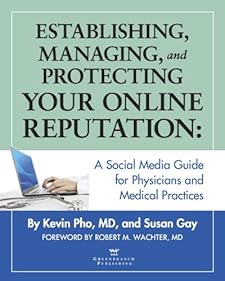
Pho understands the power of data and how it can significantly improve patients' lives. Along with Susan Gay, Pho recently co-authored Establishing, Managing, and Protecting Your Online Reputation: A Social Media Guide for Physicians and Medical Practices , a book about physician online reputation management,

Dr. Pho recently answered a few questions about his book via email.


PS: Why is an online reputation important for doctors and medical practices?


More patients than ever are going online to research their doctor. According to a study from Pew Internet, 44 percent of patients online do so. And about one in five use physician rating sites. In my own practice, I estimate that about 10 to 15 percent of patients have found me through my online presence, whether it's my blog or my LinkedIn profile.


It's important for doctors to Google themselves at least once a week and see what comes up, because that's what patients are doing. Physicians don't want to be defined by a negative news story, or a bad review from an online physician rating site. That's why it's important that they take control of their online reputation before someone else does.


When you consider how transparency has disrupted other industries, like books, movies and hotels, it's only a matter of time before the same disruption happens in health care.


PS: How can doctors, who are already busy, use social media to establish their online reputation?


I certainly understand that doctors are busy. I'm a primary care physician myself, and I see about 20 patients daily. Not many have time for social media.


But consider how long it takes to complete a LinkedIn profile. About 30 minutes or so. Doctors can fill their profiles with professional information like items from their resume or information about their practice. But those 30 minutes are incredibly powerful. Studies show that a LinkedIn profile gets ranked high on a Google search. So when patients Google a physician's name, that profile will be ranked high, perhaps pushing down the effects of third party rating sites, or negative news articles.


Some doctors may choose to stop there, and that will already put them ahead of the curve. But for some, they may want to expand their social media activity onto Twitter or Facebook, and engage with patients. Doing so expands their so-called digital footprint and makes their online presence that much more visible.


PS: Although geared towards health providers, what can patients learn from this book?


Patients can learn about how physicians on the forefront of social media are using tools like Facebook, Twitter and blogs to better connect with patients and improve care. I included not only my stories from almost 10 years in the health care social media space, but also the experiences of dozens of physicians who share how social media has affected their practice.

Patients can also learn about the current data behind physician rating sites. Despite anxiety among physicians about online ratings, studies show that many of these sites are fragmented, and contain only a few ratings per physician. Online doctor rating sites shouldn't be the sole factor when choosing a doctor, but a piece of the puzzle.


Finally, I have included stories from leading patient advocates, including "e-patient" Dave deBronkart and Kerri Morrone Sparling, who share their experience on how a physician's online reputation affected their search for medical care.


PS: What is your takeaway message from the book?


Health providers need to be proactive about their online reputation. Passivity isn't an option. Whether doctors know it or not, they already have a presence online, likely from third-party rating sites. But this information can be inaccurate, or worse, contain negative patient reviews. Is that the first online impression that you want to give patients?

Take charge of how you appear on Google. Proactively define yourself online. An online reputation will soon be just as important as a reputation in the community.


Establishing, Managing, and Protecting Your Online Reputation is available on Amazon and in ebook format.


via Books on HuffingtonPost.com http://www.huffingtonpost.com/phil-simon/online-physician-reputation_b_2970763.html?utm_hp_ref=books

Literary Fiction Is F*cking Boring

In a recent piece on the Review Review, Dan Chaon writes about the need for young writers of literary fiction to emulate their counterparts in music, and develop an obsessive interest in the products of the culture they hope to join. He bemoans his students' unfamiliarity with the litmags they hope to be published in, and encourages them to explore the literary world. He recommends the annual best-of short-fiction anthologies, and name-checks a few good magazines. "Young writers," he says in conclusion, "if you want to be rock stars, you have to read."


via Books on HuffingtonPost.com http://www.huffingtonpost.com/2013/03/29/most-contemporary-literar_n_2980871.html?utm_hp_ref=books

Gini Graham Scott: Assault on Writers From Automated Software

Professional writers today are in a crisis. Between millions of writers who are writing books and articles for free, celebrities with million dollar book deals (often written by an unknown ghostwriter), e-books transforming traditional publishers and reducing advances, and consolidations and disappearances of many book, newspaper, and magazine publishers, there are fewer paid writing opportunities -- and those that exist are often paying less. After all, there are many more non-professional writers and fewer opportunities, so it's simple supply and demand market economics.


And now there is still another assault on writers that is already here and will only get worse. The assault comes in the form of automated software that writes books and articles, further eliminating the potential jobs for writers. Sure the advantage of the software is that it can do a lot of routine writing tasks much faster and more cheaply, and as the software gets better and better -- just a matter of time, it can do more and more sophisticated writing, and the more it sounds like a real writer is writing the book and article, the more writers will be displaced. Consider the writer just another casualty of the technology revolution -- much like outsourcing and automation has eliminated many factory and service jobs to other countries, especially in Asia, or an army of helpful robots.


I became intrigued by this topic when as an author with two dozen e-books on Smashwords I read founder Mark Coker's "2013 Book Publishing Industry Predictions -- Indie Ebook Authors Take Charge," Among other things, Coker noted that "If Amazon could invent a system to replace the author from the equation, they'd do that," and went on to describe how one innovative publisher, ICON Group International has already patented a system that automatically generates non-fiction books, and he worries that as the field of artificial intelligence increases, "how long until novelists are disinter-mediated by machines." While Coker notes that over 100,000 titles by ICON are already available for sale on AMAZON, in fact, ICON's website boasts the company has published over 250,000 titles. And two other software developers, Narrative Science and Automated Insights are already doing this for clients. Right now the software is primarily used to turn large amounts of data, such as sports scores, medical research, and business stats, into insightful narratives. But it could be only a matter of time before the software starts taking over the work that journalists, non-fiction book writers, novelists, and other kinds of writers do.


So how does this all work? And I assure you, I'm writing this article! I checked out a series of articles and websites to find out.


First, take ICON International, founded by Professor Philip M. Parker, who calls himself "the most published author in the history of the planet," who as of April 2008 had already written 200,000 books, according to Noam Cohen's New York Times article "He Wrote 200,000 Books (but Computers Did Some of the Work").


Basically, Parker has developed computer algorithms that collect information on a subject which is already publicly available with the help of 60 to 70 computers and a half-dozen programmers to create books in a variety of genres. The typical books include health publications which provide information on over 700 diseases and conditions, such as The Official Patient's Sourcebook, the world outlook for different types of products such as The 2003-2008 World Outlook for Wrapped Cakes, country outlooks, such as The 2007-2012 Outlook for Deli Foods in the United States, competitiveness studies, such as the relative performance and productivity across 230 countries, trade studies of exports and imports, and company benchmarks for financial and labor productivity. But the company has also created crossword puzzles, simple poetry books, and a series of Webster's Quotations, Facts, and Phrases and is developing the software to produce romance novels, which are often written based on a popular formula. Plus now a company called EdgeMaven, is using the databases and the patents of Professor Parker to create paperback books, ebooks, games, and video titles, including TV segments, features, and mixed-media titles) for other clients by compiling information to draw basic conclusions, applying a formula to a genre, or preparing a report, film, or game as a specialist in that field might, such as writing a econometrics report.


Meanwhile, Narrative Science has created its own software to turn data, such as sports statistics, company financial reports, and housing starts and sales and turns it into articles which sound like they are written by a real writer, such as in this opening sentence featured in a New York Times article by Steve Lohr: "In Case You Wondered, a Real Human Wrote This Column."


As the computer generated article starts off: "WISCONSIN appears to be in the driver's seat en route to a win, as it leads 51-10 after the third quarter."


According to Lohr, Narrative Science, led by two of the company's founders, Kris Hamman and Larry Birnbaum, co-directors of the Intelligent Information Laboratory at Northwestern University, has developed software based on more than a decade of research to mimic human reasoning so the articles sound like a real human wrote them. For the most part, the technology is being used to help publications with limited budgets provide additional coverage, such for recaps of local sports and the quarterly financial results of local public companies. But the big problem for writers is the potential for these computer generated articles to totally replace them. As Jerry Battiste writes in The Starved Writer "Will Computers Replace Writers? (Looks As If They Already Have),"


"The stories produced by the program designed by the company, Narrative Science, are indistinguishable from those written by living breathing reports. Editors are unable to tell the difference and in tests, usually prefer the prose composed by the computer to those created by human hands and minds." In fact, the computers have gotten so good that they can now write "just about any kind of content, using any kind of data," and they can adapt it to different styles, publication tone, and specialized vocabulary. While a writer may start the process by customizing the existing platform, then the computer takes over to come up with the facts and inferences drawn from the client data, as Joe Fassler notes in an Atlantic article: "Can the Computers at Narrative Science Replace Paid Writers."


And now still another company Automated Insights, based in Durham, North Carolina is doing much the same thing, though targeting companies that want a compelling narrative to enhance their data. They start by receiving data from the customer, public repositories, and third-party data providers, analyze the data, derive and prioritize insights using powerful algorithms that determine significance based on context and uniqueness, create a narrative that tells the story in various forms from a long-form narrative, to bullet-points, tweets, and headlines, and then publish it in real time forms, including web, mobile, Twitter, email, and books.


In short, the basic technology is already there and is likely to increasingly take over jobs once held by writers. Sure writers can always write free articles and celebrity writers -- or writers interviewing and ghostwriting for celebrities -- will always be in demand. But what about other writers? And as this software becomes sophisticated, it can be used to create art, music, virtually any kind of artform, and perhaps it already has. As for me -- I think this could be a signal for taking a long vacation. At least, a computer can't enjoy the vacation for me.

________________________________________________________________


Gini Graham Scott, Ph.D. is the author of over 50 books with major publishers and has published 30 books through her own company Changemakers Publishing and Writing. She writes books and proposals for clients, and has written and produced over 50 short videos through her company Changemakers Productions Her latest books include: The Very Next New Thing: Commentaries on the Latest Developments that Will Be Changing Your Life and Living in Limbo: From the End to New Beginnings


via Books on HuffingtonPost.com http://www.huffingtonpost.com/gini-graham-scott/automated-writing-technology_b_2974756.html?utm_hp_ref=books&ir=Books

Katie Fransen: Why I'm Deleting My Goodreads Account

Today was yet another sad day for book-lovers everywhere. It's official: Amazon has purchased the book-oriented social media site Goodreads. It was a quick and unexpected announcement; Goodreads has been operated privately since its launch seven years ago. I've used Goodreads for about three years now, but today I made the decision to permanently delete my account.


I loved the site for many reasons: I could share reviews of my favorite books, keep track of how many and what books I had read in any given year, and I could get recommendations from friends and other users on the site. It was preferable to other similar sites because you could add an unlimited number of books to your account for free. I had Goodreads connected to my Facebook account so people who were not on the site could view my recommendations. But all of that changed as soon as I found out Amazon was taking over.


For years, Amazon has been buying up every successful book-related site out there. Shelfari, Abe Books, Audible, The Book Depository, and BookFinder are all owned by Amazon. Amazon even holds 40% of LibraryThing through its ownership of Abe Books.


What's so wrong with Amazon owning so much? Besides the fact that it has been proven that monopoly is in general detrimental to the economy, Amazon has made it impossible to compete by selling physical books at a loss and e-books at such low prices. Bookstores across the country have been suffering because it is so hard to compete with such prices. The only way there are surviving is by delivering a unique experience with atmosphere and great recommendations.


Goodreads was a similar neutral online platform where readers could share any title and any opinion without worrying about censorship. Will Amazon now make Goodreads users verify their purchases? Will they stop posting reviews by authors? Will they start putting sponsored recommendations in your feed? Are search results going to be based on sales rank? Goodreads had the option of purchasing a book you found on the site from many different sources -- I'm guess now there will only be one option.


I'm not going to lie -- I'm afraid. Amazon has taken over major ways of buying, publishing, and now exploring books. I don't want a giant corporation telling me what to read. I love getting the random recommendation from a friend of a book they just loved reading and couldn't put down. Word of mouth is a powerful tool in the book world.


Part of what I loved so much about Goodreads was that you had your own little community where you could interact with individuals or on a larger scale with groups. Goodreads had been the indie bookstore of online sites. You could meet with your friends and talk about books unreservedly.


What will happen now that Amazon has control of the site? I can't predict the future, but I know it will change (and not for the better). And yes, I have been speaking of Goodreads in the past tense; there is no way the Goodreads as we have known it will ever be the same. I know it may sound paranoid -- "Big Brother is coming to get you" or something like that, but every time you open a book will you be doing it because you want to, or because Amazon just told you to? I have yet to find a site that can really replace it that is not owned by Amazon.


I can only hope that someone out there will create a platform that is easy to use, has a great community of readers, and is independent.


via Books on HuffingtonPost.com http://www.huffingtonpost.com/katie-fransen/turning-my-back-on-goodre_b_2980155.html?utm_hp_ref=books

You Won't BELIEVE The Number Of Books This 13-Year-Old Has Read

Neveah Mosher -- a 13-year-old from the South Bronx -- read more in 2012 than some people do in their entire high school careers. According to HooplaHa.com, the middle schooler reads 300 books a year. This is a goal she set for herself because she wants to be the first person in her family to pursue higher education.


Watch Neveah tell her amazing story in the video above.


"The most important thing that I need to do to accomplish my dreams is to get to college," Neveah said. "Without education, you'll just be a nobody."


Neveah attends MS302 in New York City and participates in an after-school program run by City Year, a national nonprofit organization that focuses on education.


“To be able to read is the most wonderful thing ever,” Neveah said. “When you’re reading, it’s like you’re in another world and you’re seeing something from somebody else’s eyes.”


Does Neveah inspire you? How many books do you read per year? Share your thoughts in the comments below or tweet @huffpostteen!


Editor's note: At the time this video was filmed, Neveah was 12-years-old. She is now 13.


via Books on HuffingtonPost.com http://www.huffingtonpost.com/2013/03/29/neveah-mosher-13-year-old_n_2979636.html?utm_hp_ref=books&ir=Books

How Much Did Amazon Pay For Goodreads?

Valuing a social network is part art, part science, and part nonsense, but the spectrum has narrowed a bit in the past couple of years as sites like Pinterest and Twitter closed financing rounds and companies like LinkedIn hit public markets.


via Books on HuffingtonPost.com http://www.huffingtonpost.com/2013/03/29/amazon-likely-paid-1-bill_n_2979749.html?utm_hp_ref=books

Eben Alexander, M.D.: The Easter Question

What do you say to a parent who has lost a child?


Any doctor will tell you this is the toughest question there is. How could one presume to say anything to someone who has suffered such a thing?


During my years as a neurosurgeon, I operated on hundreds of children with brain ailments ranging from benign tumors to the most virulent cancers. Many of the children I operated on survived. But not all of them did, and on the occasions when they didn't, the job of telling that child's parents fell to me. These days, ever since publishing "Proof of Heaven," the story of the near-death experience I underwent four years ago, most of my time is taken up not with operating on brains but with telling my story. I've spoken to thousands of people in the past several months, and the joy I get from sharing my essential message -- that each of us is immortal, that consciousness is not contained or limited by the brain, that death is not the end, and that love is the most powerful force in the universe -- is such that I simply never tire of telling it.


But one element in my new life has taken me by surprise. I now find myself regularly confronted with that question I so dreaded as a surgeon:


Why did my child die?


I've started to think of this as "The Easter Question." For though it is asked every day, in every part of the world, by people of countless different faiths speaking countless different languages, it is a question that for Christians comes into especially sharp focus on Easter. Easter, after all, is built around Christ's arising from the grave; and from the Christian perspective, through that event the power of suffering and death was defeated once and for all. And there is quite simply no greater suffering than that experienced by a parent who loses a child. I know this not only because of my experience as a surgeon, but because my own birth-parents lost their daughter: a sister who, as I narrate in "Proof of Heaven," I never knew on earth.


Why is there death? Why is there suffering? The Christian answer to these questions is that these things exist because the world has fallen away from its original divine perfection. But Jesus, through taking birth in this world, suffering the worst that it can give and rising again into glory, has defeated the evil of this world, and the suffering that goes along with it. "In the world ye shall have tribulation," says Jesus in the Gospel of John. "But be of good cheer; I have overcome the world."


More than ever since my near death experience, I consider myself a Christian -- though one who knows that God loves all of His children, including those whose faith is expressed in traditions different from my own (while I feel that God has no gender, due to convention I use the pronoun He when I refer to Him). Any pastor will tell you that the single concept that separates the wheat (that is, the real believers) from the chaff (those who are Christians only in name), is whether a person accepts that what Christian tradition says happened on Easter Morning really happened. The entire force of the Christian message can be pushed into that moment when the rock of the cave rolled aside and Jesus -- the same and yet not the same Jesus whom his mother had watched die on the cross just two days before -- stepped out once more into common daylight. That he had, in fact, overcome death.


Now, I can tell you that if someone had asked me, in the days before my NDE, what I thought of this story, I would have said that it was lovely. But it remained just that -- a story. To say that the physical body of a man who had been brutally tortured and killed could simply get up and return to the world a few days later is to contradict every fact we know about the universe. It wasn't simply an unscientific idea. It was a downright anti-scientific one.


But it is an idea that I now believe. Not in a lip-service way. Not in a dress-up-it's-Easter kind of way. I believe it with all my heart, and all my soul.


The universe we live in is one in which everything is connected. Not just in a manner of speaking, but actually. Every atom in your body, and every subatomic particle of which those atoms are made, is in profound and direct relationship with every other atom, and every other particle, in the universe: a universe that is composed not of hard, unyielding matter but of energy. This energy, in turn, is "made" of (or "manifested" by) something called consciousness. And consciousness itself is not "made" of anything, for it transcends all materiality. If we insist on envisioning consciousness as being "made" of anything, that substance must be the Divine itself.


We are, really and truly, made in God's image. But most of the time we are sadly unaware of this fact. We are unconscious both of our intimate kinship with God, and of His constant presence with us. On the level of our everyday consciousness, this is a world of separation -- one where people and objects move about, occasionally interacting with each other, but where essentially we are always alone.


But this cold dead world of separate objects is an illusion. It's not the world we actually live in. The world we really live in has many more dimensions than we can perceive. It's one in which consciousness, soul, and spirit are not only real, but more real than the physical, and where the limitations that bind us during our time on earth will fall away whenwe leave our physical bodies behind.


From this perspective -- and it is a perspective that I now live in contact with every day -- there is quite simply nothing that the loving God who rules this world cannot do. God -- the God who can do anything, and who cares for us more than He cares even for Himself -- is never far from us. Despite the incomprehensible vastness of the worlds He commands, both visible and invisible, He is right here with each of us right now, seeing what we see, suffering what we suffer... and hoping desperately that we will keep our hope and faith in Him. Because that hope and faith will be triumphant.


Why did this happen to my child? How could a loving God, if there truly is such a being, ever let it?


This Easter, in the wake of a year that saw so much horrific tragedy -- not just for parents, of course, but for all kinds of people -- I know that if I am asked this question, I will be more than willing to answer it. Not perfectly, God knows, but honestly. The universe we live in is vast beyond imagining, but it is ruled by a God who loves us in a manner that is equally beyond imagining. And he has not forgotten us. This April, more than ever, that, for me, is what Easter is all about.


via Books on HuffingtonPost.com http://www.huffingtonpost.com/eben-alexander-md/the-easter-question_b_2979741.html?utm_hp_ref=books&ir=Books

Jackie K. Cooper: The Storyteller Is Less Than Picoult's Best

Jodi Picoult has proven with her series of novels that she is a great storyteller. Now she has written a book about storytellers that is titled The Storyteller. It is filled with Picoult's amazing way with words and showcases her ability to make any story she writes fresh and innovative. This is very important because the subject matter of The Storyteller is the Holocaust, a subject matter that has been examined in just about every way possible.


The focus of The Storyteller is on Sage Singer, a young woman who attends a grief group. She is there because of the recent death of her mother. She died as a result of a car accident in which Sage was driving. The accident left Sage with scarring on her face and this makes her reticent to be seen in public. Therefore she takes a job as a baker that allows her to work at night out of the public eye.


In her grief group is a retired teacher named Josef Teller. He is quite elderly but through the course of their meetings he comes to think of Sage as his friend. Later he asks her to help him die. She of course is horrified but then he reveals to her he was a member of Hitler's Army during World War II and that he did horrible things to the Jews.


Sage is not a practicing Jew but her grandmother is. She also was part of the members of the Jewish faith who were persecuted during the war. As Sage tries to make her decision of what to do about Teller, he begins to tell her his story. In a parallel way her grandmother begins to tell her own story. These two stories help Sage decide what she needs to do.


Picoult is such a masterful storyteller that these two stories spring to life vividly in the pages of the book. The horrors of the war are revealed in much detail, but somehow the impact of these tales is muted. We know that both of these characters have survived whatever they went through and this makes their stories less involving.


Readers will also have a difficult time pulling for Sage. She is such a contrary character, full of insecurities and at odds with her life. She manages to stay rather dispassionate about the stories she hears and this in turn makes it easier for the reader to stay untouched. At least not as touched and horrified as they should be based on the horrors that are revealed.


Still the basic Picoult touches are there such as the attention to detail, the narrative viewpoint of several characters rather than one, and a final twist that will be a surprise to some readers. All of these are plusses but they do not raise the level of reading entertainment to that of her previous novels. Picoult is one of the best writers out there today but The Storyteller is only second rate.


The Storyteller is published by Atria. It contains 460 pages and sells for $28.99.


via Books on HuffingtonPost.com http://www.huffingtonpost.com/jackie-k-cooper/jodi-picout-the-storyteller_b_2979388.html?utm_hp_ref=books

Penny C. Sansevieri: The Battle to Save Bookstores

The New York Times recently ran an article about the lack of bookstore orders across the board, but in particular for lesser-known authors. Though many might see the benefit in that -- I mean, why take up shelf space for authors who don't (yet) have a following? -- the catch is this: every author was once considered lesser-known. If we limit shelf space to only those mega-bestselling titles where will that leave us? Probably with a pretty vanilla buying experience. Lots of repetitive authors we may or may not read. Can you imagine rows and rows of E.L. James' books? The stomach lurches at the thought. One of the reasons I love hanging out in a bookstore is the process of discovery. Finding new authors I hadn't considered before, snooping through rows and rows of books all begging to be read.


The New York Times posed an interesting question: Should publishers step in to save bookstores? The answer, without question, is yes. But it's bigger than that. Consider my take on this very real problem: While publishers simply will be lost without bookstores, many people underestimate how much we'll lose if these stores go away, and I think a lot of authors miss the point of a bookstore. It's more than just a place to sell books, it's an eye to the industry, a place to check out the competition, book placement, end cap displays, etc. So let's take a look at what the real issues are:


eBooks Fad or Future? Statistics show that eBooks are sliding. Well, not sliding per se but leveling off. They just about had to, didn't they? The challenge with any "hot new thing" is that it's bound to fade, even slightly. Studies of Kindle readers show that the first month of owning a reader leads to a huge surge in buying, after that it sort of dies down for most owners. With new e-readers coming on board and the convenience of a "quick read," eBooks were hard to deny, but they won't put print out of business. They are, however, a major competitor to their paperback counterparts. Consider this: what if bookstores offered a way to buy the eBook after you browse, thereby still making the sale? You're in a bookstore, you find the book you want but decide you'd rather have it in digital form. I've done this, quickly emailing myself the title to go home and buy it from Amazon. What if I could get it right then and there, would I? You bet I would. Interesting to note that indie bookstores are already doing this, via a deal with Kobo, though Barnes & Noble is still lagging behind which is interesting considering they have their own eReader.


Amazon: Let me start here by saying that I'm not one of those people who spends their life bashing Amazon, but I do think they have some responsibility here and with Amazon Publishing a steady competitor in the market, they need bookstores. Ah, but there's one problem. They've been banned from Barnes & Noble. So, here's the deal. Both Amazon and Barnes & Noble need to go on a time out and then come back to the table and figure out how they can peacefully coexist. I had a conversation recently with someone who works for Amazon and I said, "You know Amazon needs to spend a little bit more time making nice with this industry, one day it's going to come back and bite them in the ass." That day is now here. Should Amazon care if bookstores go away? Yes, they should. They are a publisher now, not just a mammoth online e-tailer. Stop being so cocky and get in there and fight for the bookstore. Otherwise we'll end up with nothing more than Target and Wal-Mart books which are relegated to a few shelves, shoved in the back of the store. When was the last time you discovered a great new read at Wal-Mart? My point exactly.


Publishers: Should publishers step in to save bookstores? You bet. They did a fabulous job of saving book review departments. Okay so I'm being snarky here. But the reality is this, when book review departments at newspapers started failing, few if any publishers upped their ad budget. I think even a small concession here could have helped keep these review departments going, but that's all water under the bridge now. What isn't gone (yet) are bookstores and publishers need to do whatever they can to save them. What does that mean? Publishers have spent a lot of time (a lot) fighting the DRM battle and figuring out how to price eBooks. What if they took some of that energy and put it into bookstores, instead? Here's an example. Our local Fry's store has this big area that they use for game display and they have set up several of the newer, interactive games for kids to try. Even an elaborate Wii set up. This area is always packed with kids and adults trying these out. The displays are fun, colorful, and engaging. Here's a question: what would it take for a publisher to put something like that together for bookstores? Engaging the readers in a new and different way. Imagine having had that experience with any of the Harry Potter books? I'm not taking about a big gaming display, but perhaps a colorful system that would engage the kids and keep them occupied while the parents perused the store - or, even better, the kind of engagement that was so fabulous that kids actually insisted the parents take them to the bookstores to experience it. Would this cost a fortune, I don't know, but I do know that many authors are doing this online (and at a relatively low cost) to keep readers engaged and coming back to their websites. People want engagement, but it doesn't always have to be on the Internet.


Readers/Authors: Let's face it, even if you're not in a bookstore you need bookstores. We all do. Go out and support your local bookstore. Stop in a Barnes & Noble and do some shopping. Is that all it will take to save them? No, but it's a start. Authors, if you are lucky enough to have your books in bookstores then push readers to them. List on your site the stores that carry your book and send readers in there. And speaking of authors, there are many authors who made it because of bookstore support. Now it's time for the authors to do their part and support those bookstores - for the mega-selling authors, why not include some financial support? The millions of dollars earned by the top authors couldn't have occurred without stores. While it was heartening to see Jodi Picoult take to Facebook recently to promote lesser-known authors whose books weren't being carried in Barnes & Noble, that's just one small step. Authors like James Patterson, Stephen King and others who are bookstore staples, let's step up and support our bookstores.


Government's role: In France, the government plans to subsidize bookstores. Why can't we take a page from France and find a way to provide financial support for bookstores a la our federal subsidy for PBS? Maybe you are shaking your head thinking that the government has better things to do. Well, perhaps but that's the point of this piece, to get the discussion going. My take is that, candidly, with all the money we throw at things we shouldn't, wouldn't it be fantastic to have a "Save the bookstore fund?" Or perhaps we could have a check box on our income tax form that let us donate $1 to saving bookstores instead of allocating it as a political contribution. Cool, yes? Could you imagine when your kids grow up asking you "Mom, what's a bookstore?" The idea makes me shudder.


Discovery: We all scream about discovery. You can't walk into a single writers conference without hearing that word a million times. But what happens if we move all discovery online? How many readers will we lose in the process? What happens if the bookstore recommendation goes away? We've already lost a good measure of these but what if they all go away? Where will we find our books, in Target? Wal-Mart? I've seen the various ways that books can be evaluated online, from Amazon's "look inside the book" to sample chapters and other forms of electronic browsing. Still, nothing beats the actual stores in my view. Maybe I'm a little too tethered to this, maybe I need to get over it and just move on and enjoy this new, modern way of exploring books. Still, I think there's a happy medium here. Is Barnes & Noble doing everything it can to survive? I don't think so and they are certainly not without fault here. But the point is this: we're so quick to jump on fun, new trends (oooh, Pinterest, oooh Kindle Fire) let's consider whether the new can support the old.


As I cited earlier on in this piece, buying eBooks while in the bookstore, finding new ways to engage readers while they shop. Electronic displays that let readers experience the books they are considering, right there in the bookstore. Imagine the fun you could have with a "take this quiz" in the self-help section that promoted your book.


Maybe these are all pie-in-the-sky ideas. I'm not here to sell anyone on anything; what I am here to do is to encourage us -- all of us -- to pitch in and rescue these stores while we still have them to rescue. A world without bookstores? I'd rather not imagine that.


via Books on HuffingtonPost.com http://www.huffingtonpost.com/penny-c-sansevieri/bookstores_b_2975644.html?utm_hp_ref=books

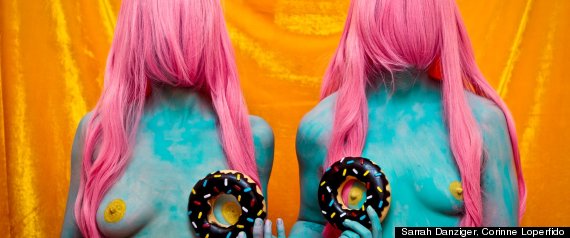
'Momma Tried' Combines Literary Journal With Nudie Mag

Merle Haggard released "Mama Tried," that twangy country song about defying the expectations of Mama, in 1968. 45 years later and the song still resonates with southern gents and rebels alike. Take Micah Learned and Theo Eliezer -- two creatives out of New Orleans hoping to release a magazine that melds the lad mags of the past with the high brow art and literary journals of today. The title? "Momma Tried."


"Momma Tried" is a print-only, nudie mag that combines the thoughtful construction of an installation piece, with the academic curation of a journal. The estimated 144-page publication contains the work and contributions of 51 people, including written, art and photography submissions from across the world as well as editorial collaborations straight out of New Orleans. However, "Momma Tried" can only come to fruition if Learned and Eliezer reach their $10,000 goal on Kickstarter. As of March 29, they have just over $7,000 with six days to go.


Learned and Eliezer said they are trying to create something that doesn't quite exist in the print world. Currently, there is a wall between the art and nude magazine realms that "Momma Tried" is trying to break down. The nudie part of the magazine is an aspect they said is integral to the human experience, like art and literature. The hunger to engage seuxality should be satiated along with the hunger to consume art and literature.


"The sexual aspect is a part of most everybody's lives, with few exceptions," Eliezer said. "We are making a magazine that appeals to people who don't necessarily consider themselves to be a part of a literary, academic or art culture So, we're able to attract a readership that might be interested in something new or something somewhat stimulating, then let them be engaged by the content beyond the nudity."


momma tried magazine


Though the magazine includes nude imagery, they were quick to make the distinction between their project and pornography, clarifying "Momma Tried" is non-heteronormative. They aim to present sexuality in a decompartamentalzied way, opening the readership to all genders, sexual orientations and persuasions.


"What we're creating isn't pornography unless it's by the most restricted, most victorian standards," Eliezer said. "We're literally presenting nude people within a conceptual context. So, it's beautiful and sexy, its engaging and there is an aspect of confidence to it. People with diverse backgrounds or ethnicity or body types will perceive it in a very open, dignified, beautiful, conceptual way."


Learned added that presenting nude art isn't their goal either, because like pornography, the medium often masks the identity and sexuality of the subject.


"Pornogaphy, not across the broard, but very often is an objectifying, object-creating medium," he said. "And then there's art nudes, which sort of creates an object but in a very different sense."


Eliezer added, "So we're neither objectifying people nor obscuring them. We're trying to find this middle ground that is much more of a reflection of who we feel we really are, and who our collaborators are."


Through this inclusivity, they said "Momma Tried" is more approachable. Art and literature can be accessible and unpretentious, regardless of someone's personal involvement in the arts.


"We want to keep it grounded and in a playful place," Learned said. "We don't want to beat people over the head with our ideas. We want people to open it up and just see the magazine for what it is."


momma tried


Though "Momma Tried" is a magazine, they said the idea is to create something closer to a book -- a publication without advertisements that someone can pour over, then not toss in the recycling bin.


"This magazine exists for us as a conceptual art piece as a whole," Eliezer said. "We wanted to create an actual work that can be collected by people, that can be treasured and eventually become this kind of sentimental object after many years have passed."


To maintain this sentimental integrity, the magazine will be print-only, a decision they said was made early on as an opportunity to revive the medium.


"It seemed like this [is a] new sort of rights for reclamation and appropriation format that we could run with and pursue in exciting ways," Eliezer said. "If nobody's paying attention to print, that means artists can reclaim it and really make it something new. Or create commentary with it as something that is a lot less commercially viable and more creatively viable."


One particular part of the interview stands out, when Learned recited a line from the Haggard song, "Mama tried to raise me better but her pleading I denied. That leaves only me to blame 'cause mama tried."


"It's not like you failed, but if you are identifying with whatever you're doing, you're not there until you figure out how to be that," he said.


Eliezer added, "And figuring out how to be a person that really lives in the truth of who you individually are."


After talking to Eliezer and Learned, the lyrics make complete sense. They are a radical duo trying to make a statement. They are creating something that goes against the grain of normalcy, but has the potential to be regarded as more than a nudie mag or a literary journal. Maybe mama did try to raise them better, but "Momma Tried" is close to becoming a reality because they simply didn't want to be.


A copy of the first issue of "Momma Tried" can be purchased through a donation of $25 to project's Kickstarter campaign.


via Books on HuffingtonPost.com http://www.huffingtonpost.com/2013/03/29/momma-tried-combines-lite_n_2966566.html?utm_hp_ref=books&ir=Books

Parker J. Palmer: An Upside-Down Easter Meditation

Years ago, I stumbled upon a little book by Julia Esquivel, the Guatemalan poet and social justice activist, titled "Threatened with Resurrection." Those few words had a huge impact on me.


I'd been taught that death is the great threat and resurrection the great hope. But at the time I found Esquivel's book, I was experiencing the death-in-life called depression. Her title jarred me into the hard realization that figurative forms of death sometimes feel comforting -- while resurrection, or the hope of new life, feels threatening.


Why? Because death-in-life can bring us a perverse sense of relief. When I was depressed, nobody expected anything of me, nor did I expect anything of myself. I was exempt from life's demands and risks. But if I were to find new life, who knows what daunting tasks I might be required to take on?


Sometimes we choose death-in-life (as in compulsive overactivity, unhealthy relationships, non-stop judgmentalism aimed at self or others, work that compromises our integrity, substance abuse, pervasive cynicism, etc.) because we're afraid of the challenges that might come if we embraced resurrection-in-life.


Every religious tradition is rooted in mysteries I don't pretend to understand, including claims about what happens after we die. But this I know for sure: as long as we're alive, choosing resurrection is always worth the risk. I'm grateful for the people and experiences that continue to help me to embrace "the threat of resurrection."


My Easter wish for everyone is the ability to say "YES!" to life. Even when life challenges us, it's a gift beyond all measure...


via Books on HuffingtonPost.com http://www.huffingtonpost.com/parker-j-palmer/an-upside-down-easter-meditation_b_2978248.html?utm_hp_ref=books&ir=Books

'Harry Potter' Actor Dies At 65

LONDON — Richard Griffiths was one of the great British stage actors of his generation, a heavy man with a light touch, whether in Shakespeare or Neil Simon. But for millions of movie fans, he will always be grumpy Uncle Vernon, the least magical of characters in the fantastical "Harry Potter" movies.


Griffiths died Thursday at University Hospital in Coventry, central England, from complications following heart surgery, his agent, Simon Beresford, said. He was 65.


"Harry Potter" star Daniel Radcliffe paid tribute to the actor Friday, saying that "any room he walked into was made twice as funny and twice as clever just by his presence."


"I am proud to say I knew him," Radcliffe said.


Griffiths won a Tony Award for "The History Boys" and appeared in dozens of movies and TV shows. But he will be most widely remembered as a pair of contrasting uncles – Harry Potter's Uncle Vernon Dursley and Uncle Monty in cult film "Withnail and I."


Griffiths was among a huge roster of British acting talent to appear in the "Harry Potter" series of films released between 2001 and 2011.


His role, as the grudging, magic-fearing guardian of orphaned wizard Harry, was small but pivotal. Griffiths once said he liked playing Uncle Vernon "because that gives me a license to be horrible to kids."


But Radcliffe recalled Griffiths' kindness to the young star.


"Richard was by my side during two of the most important moments of my career," said Radcliffe, who in 2007 starred with Griffiths in a London and Broadway production of "Equus."


"In August 2000, before official production had even begun on `Potter,' we filmed a shot outside the Dursleys', which was my first ever shot as Harry. I was nervous, and he made me feel at ease.


"Seven years later, we embarked on `Equus' together. It was my first time doing a play, but, terrified as I was, his encouragement, tutelage and humor made it a joy."


Earlier, Griffiths was the louche, lecherous Uncle Monty to Richard E. Grant's character Withnail in "Withnail and I," a low-budget British comedy about two out-of-work actors that has become a cult classic. Years after its 1987 release, Griffiths said people would regularly shout Monty's most famous lines at him in the street.


"My beloved `Uncle Monty' Richard Griffiths died last night," Grant tweeted Friday. "Chin-Chin my dear friend."


A huge stage presence with a grace rendered all the more striking by his physical bulk, Griffiths created roles including the charismatic teacher Hector at the emotional heart of Alan Bennett's school drama "The History Boys." He won an Olivier Award for the part in London and a Tony for the Broadway run, and repeated his performance in the 2006 film adaptation.


National Theatre artistic director Nicholas Hytner, who directed "The History Boys," called Griffiths' performance in that play "a masterpiece of wit, delicacy, mischief and desolation, often simultaneously."


Griffiths also played poet W.H. Auden in Bennett's "The Habit of Art," a hugely persuasive performance despite the lack of physical resemblance between the two men.


Griffiths was born in northeast England's Thormaby-on-Tees in 1947 to parents who were deaf and mute – an experience he and his directors felt contributed to his exceptional ability to listen and to communicate physically.


"The first language he learned was sign. And therefore his ability to listen to people with his eyes as well as his ears is incredible," Thea Sharrock, who directed "Equus," told The Associated Press in 2008.


Griffiths left school at 15 but later studied drama and spent a decade with the Royal Shakespeare Company, making a specialty of comic parts such as the buffoonish knight Falstaff.


On television, he played a crime-solving chef in 1990s' British TV series "Pie in the Sky," and he had parts in movies ranging from historical dramas "Chariots of Fire" and "Gandhi" to slapstick farce "The Naked Gun 2 1/2."


Known for his sense of humor, large store of rambling theatrical anecdotes and occasional bursts of temper, Griffiths was renowned for shaming audience members whose cell phones rang during plays by stopping the performance and ordering the offender to leave.


Griffiths' last major stage role was in a West End production of Neil Simon's comedy "The Sunshine Boys" last year opposite Danny DeVito. The pair had been due to reprise their roles in Los Angeles later this year.


Theater director Trevor Nunn, who as head of the Royal Shakespeare Company was one of the first to spot Griffiths' talent, said he was "an actor of rare emotional and indeed tragic power."


"Richard inspired great love and spread much happiness, and as the Shakespeare he loved put it, `There's a great spirit gone,'" Nunn said.


Griffiths is survived by his wife, Heather Gibson.


___


Jill Lawless can be reached at http://Twitter.com/JillLawless


via Books on HuffingtonPost.com http://www.huffingtonpost.com/2013/03/29/richard-griffiths-dead-harry-potter_n_2978478.html?utm_hp_ref=books&ir=Books

Sneaky Author Tricks

“No. And no again. Not that.” So says Serena Frome, the narrator of Ian McEwan’s 2012 novel, “Sweet Tooth.” What she’s protesting is a story written by her lover, Tom, in which an author at work on her second novel is scrutinized by a worried companion, a talking ape. “Only on the last page,” Serena explains, “did I discover that the story I was reading was actually the one the woman was writing. The ape doesn’t exist, it’s a specter, the creature of her fretful imagination.”


via Books on HuffingtonPost.com http://www.huffingtonpost.com/2013/03/29/sneaky-author-tricks-_n_2978234.html?utm_hp_ref=books

The Greatest Novelist You Haven't Read

It is one of the eccentricities of American publishing that James Salter has not been widely embraced as a great writer. His books are as good as those of post-war novelists like John Updike, Philip Roth, Richard Ford, and critics have often said so, and yet he is nowhere near as beloved or popularly read. He is frequently referred to as a “writer’s writer,” which sounds terrible, as if he writes effete, airless sentences, as if his novels and stories were obscure poetic exercises, but none of that is true. His writing is as muscular, as clear, as accessible, as lively as those other writers, and yet he is still somehow relegated to that dreary shelf of “writer’s writers,” but even writers have often never bothered to read him.


via Books on HuffingtonPost.com http://www.huffingtonpost.com/2013/03/29/james-salter-and-all-that_n_2978198.html?utm_hp_ref=books

Juicy Marilyn Monroe, John Lennon Letters To Be Auctioned

NEW YORK — Marilyn Monroe's letter of despair to mentor Lee Strasberg, and Dwight D. Eisenhower's heartfelt missives to his wife during World War II are among hundreds of historical documents being offered in an online auction.


Monroe's handwritten, undated letter to the famed acting teacher is expected to fetch $30,000 to $50,000 in the May 30 sale.


"My will is weak but I can't stand anything. I sound crazy but I think I'm going crazy," Monroe wrote on Hotel Bel-Air letterhead stationery. "It's just that I get before a camera and my concentration and everything I'm trying to learn leaves me. Then I feel like I'm not existing in the human race at all."


The 58 Eisenhower letters, handwritten between 1942 and 1945, range from news of the war to the Allied commander's devotion to his wife, Mamie. They are believed to be among the largest group of Eisenhower letters to survive intact and could bring up to $120,000, said Joseph Maddalena, whose Profiles in History is auctioning the items.


They are among 250 letters and documents being sold by an anonymous American collector. Selected items will be exhibited April 8-16 at Douglas Elliman's Madison Avenue art gallery.


Also included is a typed, undated draft letter from John Lennon to Linda and Paul McCartney that reflects the deep animosity between the two Beatles around the time of the foursome's formal 1971 breakup. The two-page letter is unsigned and contains corrections. A photographic logo on the stationery shows Lennon and his wife Yoko Ono within a circle with their lips almost touching.


"Do you really think most of today's art came about because of the Beatles? I don't believe you're that insane – Paul – do you believe that? When you stop believing it you might wake up!" Lennon writes. It's expected to fetch $40,000 to $60,000.


Other highlights include two large photo albums that Adolph Hitler and Benito Mussolini exchanged prior to War World II.


"When Mussolini and Hitler visited each other before the war, they would each have their photographers document their trips," Maddalena said. "They really documented the regalia, the flags, the uniforms, tanks and all the pomp and circumstance, and them speaking and reviewing the troops."


The leather-bound albums, containing hundreds of images, have a pre-sale estimate of up to $50,000.


The sale is the second of several planned online auctions of the anonymous collector's artifacts. The entire collection contains 3,000 items.


____


Online: http://www.profilesinhistory.com


via Books on HuffingtonPost.com http://www.huffingtonpost.com/2013/03/29/monroe-eisenhower-letters_n_2978064.html?utm_hp_ref=books

Critics Hate 'The Host'

LOS ANGELES — There's something about novelist Stephenie Meyer that induces formerly interesting directors to suddenly make films that are slow, silly and soporific. It happened consistently on "The Twilight Saga," and it happens again on "The Host," once-provocative writer-director Andrew Niccol's adaptation of Meyer's 600-plus-page post-Twilight novel that spent 26 weeks at No. 1 on the New York Times best-seller list beginning in 2008.


Aimed squarely at the same tweens who contributed so generously to the bank accounts of everyone who became associated with Meyer's vampire franchise, this one swills in the same sort of thwarted Victorian-style romanticism while indulging a similar moonstruck vibe that can seemingly only be resolved in Meyer's work by selfless female sacrifice. Not to be deterred, Meyer's army of female fans surely will deliver a big opening for Open Road, but anything resembling Twilight numbers is a fantasy. Meyer intends to expand The Host into a trilogy, but the second book has yet to be published, so any further films in the series remain a long way off.


Once again applying her quaintly old-fashioned morality to her specialty in cross-species attraction, Meyer this time centers on a leading lady whose dual personality hinges on an "Invasion of the Body Snatchers"-like notion of advanced aliens having taken over the bodies and lives of more flawed Earthlings. Here, however, the invasion already has taken place, and the aliens essentially have won; only a few fugitive holdouts remain, and the virtual inevitability of total human capitulation dictates the fatalistic attitude of the characters as well as the prevailing mood.


"The Earth is at peace. Our world has never been more perfect," a narrator intones at the outset – and, indeed, everything we see looks pretty darn nifty, a sort of Silicon Valley version of sanitized architectural splendor populated by well-scrubbed, politely impersonal citizens who resemble Mormon Kens and Barbies. The upside is that life is easy and stress-free. The downside is that everyone has these weird glowing blue-and-white eyes that sort of stare without seeming to fix on you or anything in particular; it would be enough to drive you insane in paradise.


In fact, so determined is Melanie (Saoirse Ronan) not to undergo this eye change that she jumps out a window to avoid becoming one of "them." She survives, however, and once she's implanted via simple surgery with some fluid, floating particles that are said to constitute her new soul, she adapts to her outwardly serene revised personality readily enough. Taking the new name Wanderer with the approval of her overseer called Seeker (Diane Kruger), who hopes to learn the identities of other human renegades from her, she tries to co-exist with her old inner self, which talks back at her with sharp shrieks, commands and complaints from within whenever "Melanie" disapproves of what "Wanderer" is doing.


Melanie also asserts herself in dreams, which provide a reminder of her burgeoning romance with Jared (Max Irons), her little brother Jamie (Chandler Canterbury) and others. Her old self gaining the upper hand, Wanderer/Melanie escapes to the desert and ultimately rejoins her little family, which also includes rebel group leader Uncle Jeb (William Hurt), Aunt Maggie (Frances Fisher) and a handsome dude named Ian (Jake Abel) who attracts Wanderer, now called Wanda, while Melanie remains faithful to Jared.


Much hilarity, of uncertain intentionality, stems from the internal battle between the two women whenever Wanda/Melanie gets into a romantic mood with either of her young gentlemen friends; Melanie's barked protestations when Wanda entertains Ian's overtures are particularly abrupt and sometimes legitimately funny. At another point, Melanie disappears altogether, provoking thoughts that she might have perished or, more likely, just gone into a sulk.


The long stretch spent with the isolated guerrilla band is endowed with a certain visual splendor for being set mostly underground in soaring red-rock caves in the American Southwest, specifically in the vicinity of northwestern New Mexico's spectacular Shiprock mountain that juts out of the desert landscape like an iceberg from the sea. The melodrama also should benefit from the internal bickering and fateful decision-making of the group, as well as from the urgent search effort undertaken by Seeker and other alien agents.


Instead, this is where the film becomes suffocated by the sort of lethargy and indulgent extension of ennui and indecision that progressively afflicted the Twilight series; instead of building dramatic momentum, the film engorges itself on dithering and procrastination, ultimately cocooning itself in an emotional numbness quite at odds with the life-and-death struggles being enacted by the central characters.


From his early work on The Truman Show and Gattaca through the recent In Time, Niccol has spent most of career on science- and speculative-fiction material. The futuristic setting imagined by Meyer is comparatively simple and lacking in complexity; she's much less interested in social and ideological structures and advanced technology than in the impassioned impulses of her young heroines, which is the key reason her work has been so overwhelmingly successful.


In the end, this is a survival story, positioned in the familiar but recast setting of the American West, one that pivots on a heroine who not only seeks something to live for but something worth dying for. Unfortunately, it's cloaked in yawningly familiar teen-romance terms and cries out for even a little seasoning of wit, irreverence, political smarts and genre twists that, given the well-trod terrain, seem like requisites when presenting visions of the near future.


The fine actress Ronan, who was just 17 when filming began, is required to carry by far the most weight and does so capably, though she is partially handicapped in connecting with the audience by those damn eyes. Not so encumbered are the male leads, played appealingly, within limits, by Irons and Abel. The futuristic setting is gently indicated, whenever possible by ultra-modern existing buildings and modified vehicles, while the visual effects are pretty standard. Brazilian composer Antonio Pinto works overtime to impose some emotional and dramatic unity on the overlong piece, to variable effect.


"The Host," an Open Road Films release, is rated PG-13 for some sensuality and violence. Running time: 125 minutes.


___


Motion Picture Association of America rating definition for PG-13: Parents strongly cautioned. Some material may be inappropriate for children under 13.


___


www.hollywoodreporter.com/news/breaking-dawn-stephenie-meyer-casting-393991


www.hollywoodreporter.com/heat-vision/twilight-host-a-stephenie-meyer-431467


via Books on HuffingtonPost.com http://www.huffingtonpost.com/2013/03/29/the-host-review_n_2978035.html?utm_hp_ref=books&ir=Books